Baobab Tree
African tree of life
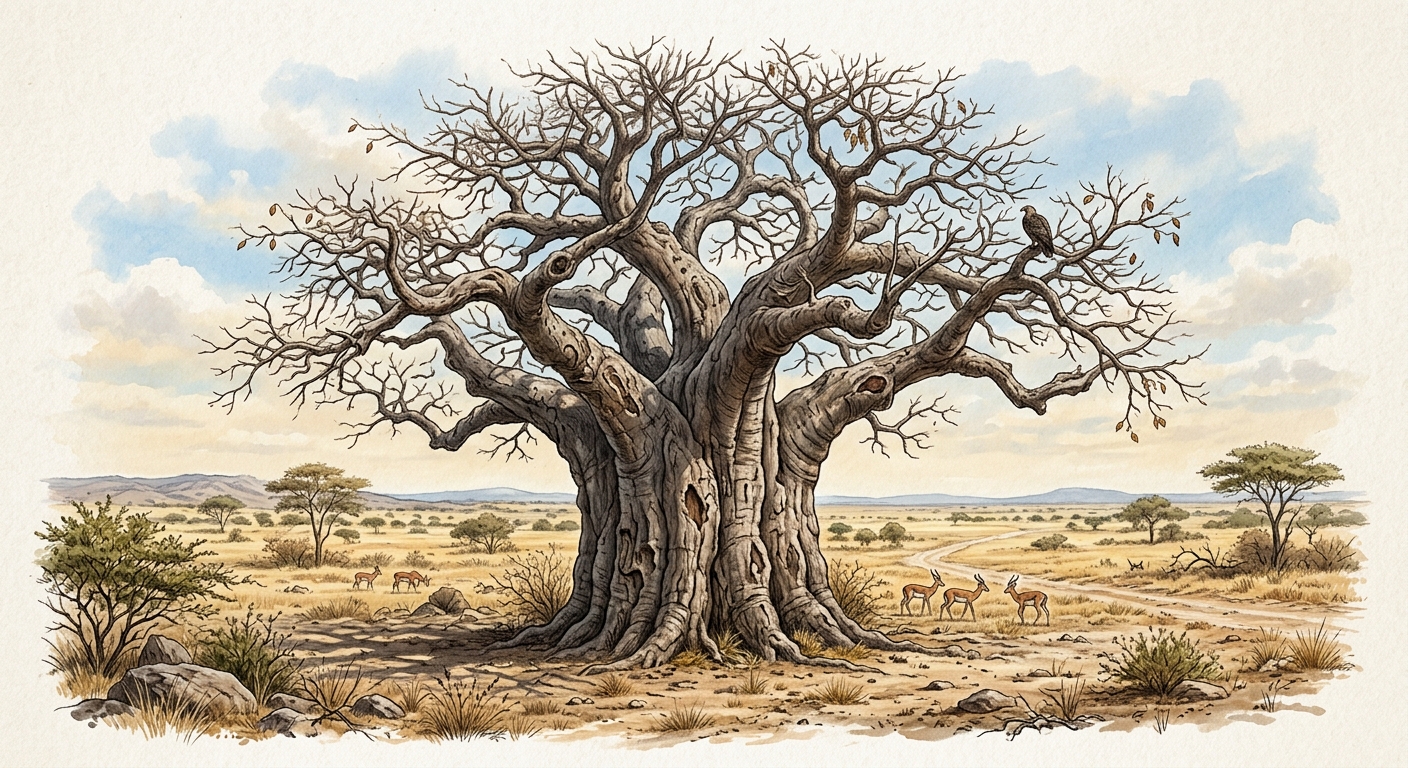
The African baobab (Adansonia digitata) is an iconic, massive deciduous tree native to sub-Saharan Africa, known for its enormous trunk that stores water and its distinctive upside-down appearance when leafless. These trees can live for thousands of years and are deeply embedded in African cultures, providing food, medicine, and shelter.
Overview
Adansonia digitata, commonly known as the African baobab, is a majestic tree species belonging to the family Malvaceae. Distinguished by its disproportionately thick trunk relative to its height, the baobab can reach trunk diameters of 10-14 meters and heights of 20-30 meters. The tree's ability to store thousands of liters of water in its fibrous trunk tissues enables it to survive prolonged droughts in the African savanna. The baobab's distinctive appearance varies dramatically with the seasons. During the wet season, it produces large palmate leaves with 5-7 leaflets and spectacular white flowers that hang on long stalks. When leafless during the dry season, its gnarled branches resemble roots reaching skyward, giving rise to the legend that the tree grows upside-down. The tree produces large, oval fruits containing a powdery pulp rich in vitamin C and other nutrients. Baobabs are keystone species in African ecosystems, providing habitat and food for numerous animals. Elephants consume the bark and pulp, birds nest in trunk cavities, and various mammals feed on the fruits. The tree's ecological and cultural importance cannot be overstated, as it has sustained human populations for millennia through its edible leaves, fruits, bark fiber, and medicinal properties. Recent studies have raised concerns about the die-off of some of Africa's oldest baobabs, possibly linked to climate change.
How to identify
The baobab is unmistakable due to its massive, bottle-shaped trunk with smooth, greyish-brown bark that appears shiny or metallic. The trunk can be 10-14 meters in diameter. Leaves are deciduous, palmate, and divided into 5-7 elongated leaflets, each 5-15 cm long. The tree is leafless for much of the year. White, pendulous flowers are large (10-20 cm diameter) with five petals and numerous stamens, appearing waxy and fragrant. The woody, ovoid fruits are 15-30 cm long, covered in velvety greenish-brown skin, and contain kidney-shaped seeds embedded in dry, chalky pulp.
Habitat
Adansonia digitata thrives in hot, dry savannas, open woodlands, and grasslands at elevations from sea level to 1,500 meters. The tree prefers well-drained soils and areas with distinct wet and dry seasons, typically receiving 300-800 mm of annual rainfall. It is commonly found in regions with high temperatures and can tolerate poor, sandy, or rocky soils.
Distribution
The African baobab is native to mainland Africa across the semi-arid Sahel region and sub-Saharan savannas. Its range extends from Senegal and Mauritania in the west across to Sudan, Ethiopia, and Somalia in the east, and south through East Africa to South Africa, Botswana, Namibia, and Mozambique. The tree has also been introduced to other tropical regions worldwide.
Diet
Baobabs require full sun exposure and are adapted to nutrient-poor soils. They are drought-tolerant once established and prefer well-drained sandy or loamy soils with pH ranging from acidic to alkaline. The tree has minimal nutritional requirements and can grow in rocky terrain where other trees cannot survive. During the wet season, the tree actively photosynthesizes and stores water and nutrients in its trunk.
Behavior
Baobabs exhibit deciduous behavior, shedding all leaves during the dry season to conserve water. The massive trunk serves as a water storage organ, allowing the tree to survive months without rainfall. Growth is extremely slow, with trunk expansion occurring primarily during wet seasons. The tree produces hollow cavities in older specimens, which can hold thousands of liters of water. Some baobabs develop multiple trunks through fusion of individual stems. The bark is fire-resistant and can regenerate after damage.
Reproduction & life cycle
Baobabs are pollinated primarily by fruit bats and bush babies (galagos) that visit the night-blooming flowers for nectar. Flowers open in late afternoon and remain viable for only 24 hours. The hard-shelled fruits mature over several months and can remain on the tree for extended periods. Seeds have hard coats requiring scarification for germination, often achieved through passage through animal digestive systems. Sexual maturity is reached at approximately 20-25 years. Trees can also regenerate from root suckers or coppice from cut stumps.
When to look
Flowers appear during the hot, dry season or early wet season (October to December in Southern Hemisphere regions). Fruits mature during the dry season. Leaves are present during the rainy season (approximately November to March in southern Africa). Best observed year-round, but most distinctive when leafless during dry months.
Cultural significance
The baobab holds immense cultural significance across Africa, often considered sacred and serving as community gathering places. The fruit pulp is consumed fresh or made into beverages and is marketed globally as a superfood. Young leaves are eaten as vegetables, and seeds yield edible oil. The bark fiber is used for rope, baskets, and cloth. Traditional medicine utilizes various tree parts to treat fever, malaria, diarrhea, and other ailments. Baobabs feature prominently in African folklore, with numerous legends explaining their unusual appearance. The tree appears in Antoine de Saint-Exupéry's 'The Little Prince' and serves as a symbol of African heritage.
Similar species
- Adansonia grandidieri (Grandidier's baobab, endemic to Madagascar)
- Adansonia za (Za baobab, Madagascar)
- Bombax ceiba (Red silk-cotton tree, similar trunk structure)
Watch on YouTube
Search YouTube for "African baobab tree Adansonia digitata wildlife documentary"Share notes, corrections, or add local knowledge. Text · Images · Videos · Links.