Coconut
The coconut palm (Cocos nucifera) is a tropical monocot tree producing large drupes (coconuts) with edible white meat and nutritious water. It is one of the most economically important palms, cultivated throughout tropical coastal regions worldwide.
Overview
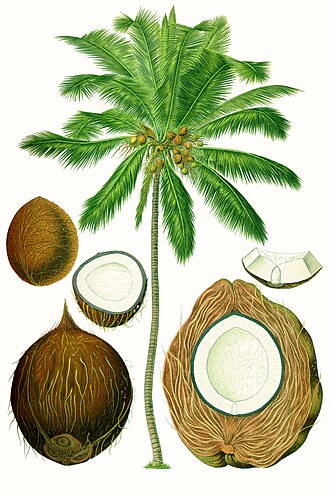
Cocos nucifera, commonly known as the coconut palm, is a tall, single-stemmed palm species belonging to the family Arecaceae. Native to tropical regions of the Indo-Pacific, it has been widely distributed by humans and ocean currents across tropical coastlines globally. The tree can reach heights of 20-30 meters and is characterized by its smooth, slender, often curved trunk marked with ring-like leaf scars and crowned with large pinnate fronds. The coconut fruit is a drupe consisting of a fibrous outer husk (mesocarp) surrounding a hard shell (endocarp) containing white edible flesh (endosperm) and coconut water. Every part of the plant has traditional uses: the nut provides food, oil, and milk; the husk yields coir fiber; the trunk supplies timber; and the leaves are used for thatching and weaving. Coconut palms thrive in sandy, well-drained soils near coastlines and can tolerate salt spray, making them iconic components of tropical beach landscapes. Coconuts are vital to the economies and cultures of many tropical nations. The plant exhibits remarkable resilience, withstanding strong winds and cyclones due to its flexible trunk and deep root system. Commercial cultivation occurs extensively in Indonesia, the Philippines, India, and other tropical countries, with millions of people depending on coconut products for their livelihoods. The species shows considerable morphological variation with two main varieties: tall varieties (typica) that grow slowly and live longer, and dwarf varieties (nana) that mature faster but have shorter lifespans. Cross-pollination between palms is facilitated primarily by wind and insects, though many varieties can also self-pollinate to varying degrees.
How to identify
Coconut palms are identified by their tall (20-30 m), slender, unbranched trunks that are smooth and gray-brown with distinctive horizontal ring scars from fallen fronds. The crown consists of 20-30 large pinnate leaves (fronds) that are 4-6 meters long with numerous leaflets arranged along a central rachis. The inflorescence emerges from leaf axils as a branched spadix protected by a spathe. The fruit is a large drupe 20-30 cm long, ovoid to nearly spherical, with a smooth outer skin (exocarp), thick fibrous husk (mesocarp), hard woody shell (endocarp), and white fleshy endosperm surrounding a central cavity filled with liquid endosperm (coconut water). Mature fruits typically have a green, yellow, or brown outer skin depending on variety and ripeness.
Habitat
Coconut palms grow naturally in tropical coastal areas with sandy, well-drained soils and abundant sunlight. They thrive in warm, humid climates with temperatures between 20-32°C and annual rainfall of 1500-2500 mm. The species shows remarkable salt tolerance and is commonly found along beaches, coastal plains, and estuaries. Coconuts require full sun exposure and do not tolerate frost or prolonged drought, though established trees can withstand short dry periods.
Distribution
Native to the Indo-Pacific region, likely originating from coastal areas of Southeast Asia, Melanesia, or the Indian subcontinent. Now widely cultivated and naturalized throughout tropical regions worldwide, including the Pacific Islands, Caribbean, Central and South America, Africa, South Asia, and Southeast Asia. Major producing countries include Indonesia, Philippines, India, Sri Lanka, Brazil, Thailand, and Vietnam.
Diet
Coconut palms require full sun exposure (minimum 6-8 hours daily), well-drained sandy or loamy soils rich in organic matter, and adequate moisture especially during establishment. They benefit from soils with pH 5.5-8.0 and thrive in saline conditions near coastlines. Trees require regular nitrogen, phosphorus, potassium, and micronutrients (especially chlorine and boron) for optimal growth and nut production. Mulching and organic matter incorporation improve soil fertility and water retention.
Behavior
Coconut palms exhibit continuous growth with new fronds emerging from the apical meristem throughout the year in favorable conditions. The trunk grows steadily upward while older lower fronds senesce and drop, leaving characteristic scars. Trees begin flowering 6-10 years after planting (dwarf varieties flower earlier at 3-4 years). Inflorescences develop sequentially in leaf axils, producing both male and female flowers on the same spadix (monoecious). The palm shows phototropism and can bend toward light, resulting in the characteristic curved trunks often seen in coastal plantings. Root systems are adventitious and fibrous, typically extending 1-2 meters deep with lateral spread.
Reproduction & life cycle
Coconut palms are monoecious with protandrous flowers (male flowers mature before female flowers on the same inflorescence). Pollination occurs primarily through wind with some insect assistance. Each spadix produces numerous small male flowers and fewer, larger female flowers. After pollination, fruits develop over 11-12 months, maturing into full-sized coconuts. A single palm can produce 30-75 nuts annually depending on variety and growing conditions. Seeds (nuts) can remain viable for months and naturally disperse via ocean currents, with the buoyant fibrous husk enabling long-distance flotation. Germination occurs when nuts reach suitable coastal habitats, with the haustorium absorbing nutrients from the endosperm to support the emerging seedling.
When to look
Coconut palms flower and fruit year-round in tropical climates, though peak production may vary by region and rainfall patterns. Harvest typically occurs continuously throughout the year, with fruits maturing 11-12 months after pollination. Young green coconuts for drinking are harvested at 6-7 months, while mature nuts for copra are collected at 11-12 months.
Cultural significance
Coconuts hold profound cultural and economic importance across tropical regions, often called the 'tree of life' due to its versatile uses. The fruit provides food, drink, oil, and milk; husks yield coir fiber for ropes, mats, and brushes; shells serve as containers, fuel, and charcoal; trunks provide timber for construction; leaves are used for thatching, weaving, and traditional ceremonies. Coconut oil is used in cooking, cosmetics, and traditional medicine. In Hindu rituals, coconuts symbolize purity and are offered in temples. Pacific Island cultures have elaborate traditions around coconut cultivation and use. The palm appears in national symbols, flags, and emblems of several tropical nations. Coconut products support millions of smallholder farmers globally.
Similar species
- Queen Palm (Syagrus romanzoffiana)
- Oil Palm (Elaeis guineensis)
- Palmyra Palm (Borassus flabellifer)
Watch on YouTube
Search YouTube for "Cocos nucifera coconut palm tree lifecycle documentary"Share notes, corrections, or add local knowledge. Text · Images · Videos · Links.
