Coconut Palm
Iconic tropical coastal palm
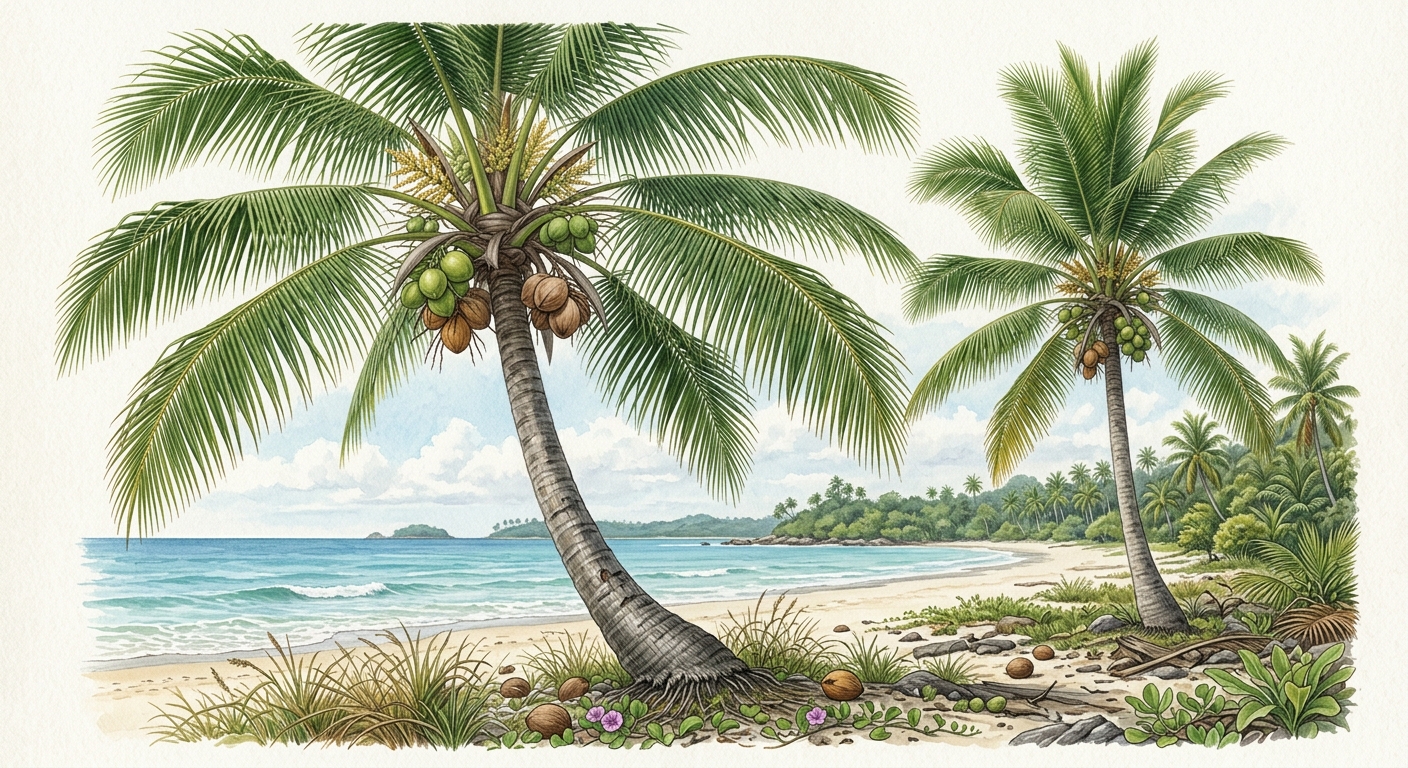
The Coconut Palm is a tall, slender tropical tree known for its iconic coconuts and graceful feather-like fronds. It is one of the most economically important palms worldwide, providing food, oil, fiber, and building materials to millions of people.
Overview
Cocos nucifera, commonly known as the Coconut Palm, is a member of the palm family (Arecaceae) and is likely the most widely cultivated palm species globally. This monoecious tree is characterized by its tall, unbranched trunk topped with a crown of large pinnate leaves. The tree produces the familiar coconut fruit, which is actually a drupe containing the seed within a hard shell surrounded by fibrous husk material. The Coconut Palm thrives in tropical coastal environments and has been cultivated and transported by humans across tropical regions for thousands of years, making its exact native origin difficult to pinpoint, though it is generally believed to have originated in the Indo-Pacific region. The tree is remarkably adapted to ocean dispersal, with buoyant fruits capable of surviving months at sea and germinating on distant shores. Every part of the coconut palm has traditional and commercial uses. The fruit provides coconut water, coconut meat (copra), and coconut oil. The leaves are used for thatching and weaving, the trunk for timber, the sap for sugar and toddy, and the fibrous husk (coir) for rope and matting. This versatility has made the species essential to tropical coastal communities and a major agricultural commodity. Coconut Palms are well-adapted to sandy, saline soils and can tolerate salt spray, making them ideal for coastal planting. They require warm temperatures year-round and abundant moisture, though they are surprisingly drought-tolerant once established. The species plays an important ecological role in stabilizing coastal soils and providing habitat for various organisms.
How to identify
Coconut Palms are tall, slender trees reaching 20-30 meters in height with a smooth, gray-brown, often curved trunk marked with ring-like leaf scars. The crown consists of 20-30 large pinnate (feather-like) leaves, each 4-6 meters long with numerous leaflets arranged along a central rachis. The leaves arch gracefully outward and downward from the crown. The trunk diameter is typically 30-50 cm and lacks branches. Coconuts are easily recognizable, oval to rounded, 20-30 cm long, with a smooth outer husk that turns from green to yellow or brown when ripe, enclosing the familiar hard-shelled seed. Inflorescences emerge from the leaf axils, producing both male and female flowers on the same structure.
Habitat
Coastal areas with sandy, well-drained soils, particularly in tropical and subtropical regions. Thrives in full sun, warm temperatures (above 20°C year-round), and high humidity. Commonly found near beaches, in coconut plantations, and in village settings throughout the tropics. Tolerates salt spray and saline soils better than most tree species.
Distribution
Pantropical distribution, cultivated throughout tropical coastal regions worldwide. Native range is debated but likely includes the Indo-Pacific region, possibly originating from Southeast Asia, the Indian subcontinent, or Pacific islands. Now extensively grown in tropical Asia, Africa, Latin America, the Caribbean, Pacific islands, and parts of subtropical regions where frost does not occur.
Diet
Requires full sunlight and well-drained sandy or loamy soils, though tolerates a range of soil types including saline coastal soils. Prefers regular moisture but is moderately drought-tolerant once established. Benefits from organic matter and responds well to fertilization with potassium, nitrogen, and chloride. Optimal growth occurs with annual rainfall of 1500-2500 mm and temperatures between 27-32°C.
Behavior
Grows continuously throughout the year in suitable climates, producing new leaves from the central growing point (apical meristem) at a rate of approximately one new frond per month. Old leaves naturally senesce and fall, maintaining the characteristic crown of 25-35 leaves. The palm begins flowering and fruiting 4-6 years after germination, with production continuing for 60-80 years. Exhibits heliotropic tendencies, often leaning toward light sources or oceanward. The trunk often develops a characteristic curve.
Reproduction & life cycle
Monoecious, producing both male and female flowers on the same inflorescence, which emerges monthly from leaf axils. Flowers are primarily cross-pollinated by wind and insects. After pollination, fruits develop over 12 months, with a mature palm producing 50-200 coconuts annually depending on variety and growing conditions. The coconut fruit is a fibrous drupe; the entire fruit can float and remain viable for months, enabling ocean dispersal. Germination occurs when the nut is partially buried, with the shoot emerging through one of the three germination pores. The seedling draws nutrition from the endosperm (coconut meat) and coconut water for several months before becoming self-sufficient.
When to look
Flowers and fruits year-round in tropical climates with no distinct seasonality. Coconuts can be harvested throughout the year, though production may peak during certain months depending on local rainfall patterns. Best observed any time of year in tropical coastal regions.
Cultural significance
One of the most culturally and economically significant plants in tropical regions, often called the 'Tree of Life' for its numerous uses. Coconut products are integral to cuisines across Asia, the Pacific, and the tropics. Coconut oil is used in cooking, cosmetics, and traditional medicine. The tree features prominently in Hindu, Buddhist, and various Pacific Islander religious ceremonies. Palm leaves are used in religious festivals and traditional crafts. The toddy (sap) is fermented for alcoholic beverages or boiled down for palm sugar. Coir fiber is used for ropes, mats, and brushes. The hard shell is carved into utensils and crafts. Coconut remains vital to the economy and subsistence of millions in coastal tropical communities.
Similar species
- Elaeis guineensis (African Oil Palm)
- Phoenix dactylifera (Date Palm)
- Syagrus romanzoffiana (Queen Palm)
Watch on YouTube
Search YouTube for "coconut palm tree growth lifecycle"Share notes, corrections, or add local knowledge. Text · Images · Videos · Links.