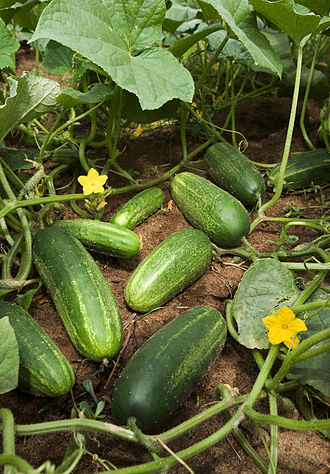
Cucumber
Cucumis sativus is an annual climbing vine cultivated worldwide for its edible cylindrical fruit. Native to South Asia, it is one of the most important vegetables globally, consumed fresh, pickled, or processed.
Overview
The cucumber (Cucumis sativus) is a widely cultivated creeping vine in the gourd family Cucurbitaceae. Thought to have originated in the Indian subcontinent over 3,000 years ago, cucumbers have been domesticated and spread throughout the world as a staple vegetable crop. The plant produces long, green, cylindrical fruits that are typically harvested before full maturity for consumption. Cucumber plants are tender annuals with coarse, hairy stems that climb via tendrils or sprawl along the ground. The fruits vary considerably in size, shape, and surface texture depending on variety, ranging from small pickling types to long slicing cucumbers. Modern cultivars are classified into slicing, pickling, and burpless types, with numerous hybrid varieties developed for disease resistance, yield, and fruit quality. Cucumbers are composed of approximately 95% water, making them extremely hydrating and low in calories. They are grown commercially in greenhouses and open fields across temperate and tropical regions. The species has been extensively bred for agricultural traits including parthenocarpy (fruit development without pollination), disease resistance, and uniform fruit shape. While traditionally a summer crop, greenhouse production now makes cucumbers available year-round in many markets.
How to identify
Cucumber plants have large, triangular to heart-shaped leaves with 3-7 pointed lobes and prominent veins, measuring 10-20 cm across. The leaves and stems are covered with coarse, hispid hairs. Stems are angular, rough-textured, and climb using branched, coiling tendrils. Flowers are yellow, 2-4 cm in diameter, typically with separate male and female flowers (monoecious). Fruits are cylindrical to oblong, usually 15-30 cm long in slicing varieties, with smooth to warty skin that is typically dark green, sometimes with pale stripes or mottling. Small spines or tubercles may be present on immature fruits.
Habitat
Cucumbers thrive in warm, sunny locations with well-drained, fertile soil rich in organic matter. They require full sun exposure (6-8 hours daily) and protection from strong winds. Optimal growing temperatures range from 18-30°C, with poor tolerance for frost or prolonged cool conditions. Commercial cultivation occurs in open fields, raised beds, and controlled greenhouse environments with trellising systems.
Distribution
Native to the foothills of the Himalayas in South Asia, cucumbers are now cultivated on every continent except Antarctica. Major production regions include China (producing over 70% of global output), Turkey, Iran, Russia, Ukraine, Spain, Mexico, and the United States. The species has naturalized in some regions but is primarily grown as an agricultural crop rather than persisting in wild populations.
Diet
Cucumbers require fertile, well-drained soil with pH 6.0-7.0, rich in organic matter and nitrogen. They are heavy feeders benefiting from regular fertilization with balanced nutrients, particularly nitrogen for vegetative growth and phosphorus-potassium for fruit development. Consistent moisture is essential, with 2.5-5 cm of water weekly through drip irrigation or soaking. Plants need full sun exposure and perform poorly in waterlogged or compacted soils.
Behavior
Cucumber vines are vigorous climbers that use spiral tendrils to grasp support structures, though they can also sprawl along the ground. Plants exhibit indeterminate growth in many varieties, continuously producing new leaves, flowers, and fruits throughout the growing season. Flowers open in early morning and are primarily pollinated by bees. Some modern cultivars are gynoecious (producing only female flowers) or parthenocarpic (setting fruit without pollination), traits developed for greenhouse production. Fruits develop rapidly, reaching harvest size within 8-12 days after flowering.
Reproduction & life cycle
Cucumbers typically produce separate male and female flowers on the same plant. Male flowers appear first, followed by female flowers identifiable by the small immature fruit (ovary) at the base. Pollination by bees or hand-pollination transfers pollen to female flowers, initiating fruit development. Seeds develop within the fruit cavity and are viable when the fruit reaches full maturity (yellow color). Plants complete their life cycle in 50-70 days from seed to mature fruit. Seeds remain viable for 5-10 years under proper storage conditions.
When to look
Summer crop in temperate regions (planted after last frost, harvested June-September); year-round in tropical climates and greenhouses. Seeds germinate in 3-10 days; harvest begins 50-70 days after planting.
Cultural significance
Cucumbers have been cultivated for over 3,000 years and are mentioned in ancient texts including the Bible and Epic of Gilgamesh. They hold importance in cuisines worldwide, from fresh salads to fermented pickles, Korean kimchi, and Middle Eastern salads like fattoush. In traditional medicine, cucumbers are used topically for skin care and to reduce swelling. The phrase "cool as a cucumber" references the fruit's internal temperature remaining cooler than ambient air. Cucumbers feature in folklore and agricultural festivals across cucumber-growing regions. Wild relatives of cucumber are important genetic resources for crop improvement.
Similar species
- Cucumis melo (melons and cantaloupes)
- Cucumis anguria (West Indian gherkin)
- Luffa cylindrica (smooth luffa/sponge gourd)
Watch on YouTube
Search YouTube for "cucumber growing lifecycle farm cultivation"Share notes, corrections, or add local knowledge. Text · Images · Videos · Links.
