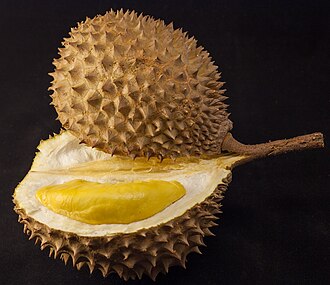
Durian
Durian (Durio zibethinus) is a large tropical fruit tree native to Southeast Asia, renowned for producing spiky, pungent fruits that are highly prized in the region. The tree can reach 25-50 meters in height and bears fruits weighing 1-3 kg with a distinctive odor and creamy, custard-like flesh.
Overview
Durio zibethinus, commonly known as durian, is a tall tropical tree species belonging to the family Malvaceae. Native to Borneo and Sumatra, it has been cultivated throughout Southeast Asia for centuries and is considered the 'King of Fruits' in the region. The tree is an emergent canopy species in lowland rainforests, characterized by its buttressed trunk and evergreen foliage. The durian fruit is notorious for its strong, polarizing odor, often described as a combination of savory, sweet, and pungent notes. Despite the challenging smell, the flesh is highly valued for its rich, creamy texture and complex flavor profile combining sweet, savory, and custard-like qualities. The fruit's exterior is covered in formidable sharp spines, protecting the soft interior compartments containing large seeds surrounded by edible arils. Durian trees thrive in humid tropical climates with consistent rainfall and high temperatures. They are primarily pollinated at night by bats and certain moth species, with flowers opening in the late afternoon. The fruit typically takes 3-4 months to mature after pollination. Commercial cultivation has spread throughout Southeast Asia, with Thailand, Malaysia, and Indonesia being major producers. The species plays an important ecological role in tropical rainforests, providing food for various animals including orangutans, elephants, and tigers. The large seeds are dispersed by mammals that consume the fallen fruits. Durian cultivation has significant economic importance in Southeast Asia, supporting local economies and international trade.
How to identify
Durian trees are large, reaching 25-50 meters tall with straight trunks up to 120 cm in diameter, often with prominent buttress roots. Leaves are evergreen, alternate, oblong to elliptic, 10-18 cm long, with a glossy dark green upper surface and silvery or bronze-colored scales underneath. Flowers are large (5-7 cm), pale yellow to white, and borne in clusters directly on older branches and trunk (cauliflory). Fruits are distinctive, oval to round, 15-30 cm long, covered with hard pyramidal spines, green to brown when ripe, weighing 1-3 kg on average (up to 7 kg).
Habitat
Lowland tropical rainforests, typically below 700 meters elevation, requiring high humidity, consistent rainfall (1500-2000 mm annually), and temperatures between 24-30°C. Prefers deep, well-drained, slightly acidic soils rich in organic matter. Often found on river valleys and slopes in primary and secondary forests.
Distribution
Native to Borneo and Sumatra in Indonesia. Widely cultivated throughout Southeast Asia including Malaysia, Thailand, Philippines, Vietnam, Cambodia, Myanmar, and southern regions of India and Sri Lanka. Also grown in tropical regions of Australia, East Africa, and experimentally in South America and Hawaii.
Diet
Requires deep, fertile, well-drained soils with pH 6-7, rich in organic matter. Needs full sunlight exposure for optimal fruit production, though young trees tolerate partial shade. Benefits from regular rainfall or irrigation, requiring consistent moisture especially during flowering and fruiting. Heavy feeder requiring nitrogen, phosphorus, potassium, and micronutrients including boron and zinc.
Behavior
Exhibits cauliflory, producing flowers and fruits directly on the trunk and older branches. Shows mast fruiting behavior with synchronous fruiting periods within populations. Nocturnal flowering with flowers opening in late afternoon and remaining viable for one night. Self-incompatible, requiring cross-pollination for fruit set. Fruits mature and fall naturally when ripe, typically at night or early morning.
Reproduction & life cycle
Trees begin flowering at 4-5 years when grafted, 8-10 years from seed. Flowers are hermaphroditic, pollinated primarily by cave fruit bats (Eonycteris spelaea) and large flying foxes, with some contribution from nocturnal moths and beetles. Flowering typically occurs 1-2 times annually depending on cultivar and climate. After pollination, fruits develop over 90-120 days. Each fruit contains 1-7 large seeds (2-6 cm) surrounded by edible arils. Seeds are recalcitrant and germinate within days of dispersal.
When to look
Flowering typically occurs during dry-to-wet season transitions. Main fruiting season varies by region: June-August in Thailand and Malaysia, November-February in southern regions. Some cultivars produce two crops annually. Fruit ripens 3-4 months after flowering and falls when mature.
Cultural significance
Considered the 'King of Fruits' in Southeast Asia with deep cultural importance in Malaysia, Thailand, and Indonesia. Featured in festivals, folklore, and traditional ceremonies. Used in traditional medicine for treating fever, jaundice, and skin conditions; seeds are roasted and eaten. Fruit banned in many hotels and public transport due to odor. Significant economic crop supporting regional economies. Numerous cultivars have been developed with distinct flavor profiles, commanding premium prices. Subject of agricultural research for improving yields and varieties.
Similar species
- Durio graveolens (red durian)
- Durio kutejensis (lahong)
- Artocarpus heterophyllus (jackfruit)
Watch on YouTube
Search YouTube for "durian tree flowering fruiting Southeast Asia"Share notes, corrections, or add local knowledge. Text · Images · Videos · Links.
