Food Pulse
vegetables
vegetables · species

Garlic

Allium sativum
Garlic

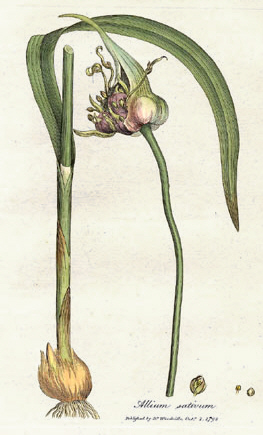
Garlic (Allium sativum) is a bulbous perennial plant in the onion family, cultivated worldwide for its pungent, flavorful bulbs composed of individual cloves. Originating from Central Asia, it has been used for thousands of years as both a culinary ingredient and medicinal herb.

Overview

Garlic is a herbaceous perennial plant that grows from a bulb and belongs to the Amaryllidaceae family (formerly Alliaceae). The plant typically reaches 30-60 cm in height with flat, linear leaves emerging from the base. The underground bulb, which is the primary harvested portion, consists of 4-20 individual segments called cloves, each wrapped in papery white, pink, or purple sheaths. The entire bulb is encased in a protective outer skin. This species is no longer found in the wild and exists only in cultivation, making it one of the oldest cultivated plants in human history. Garlic is believed to have originated in the mountainous regions of Central Asia, possibly from the wild species Allium longicuspis. It has been selectively bred for thousands of years, resulting in numerous cultivars adapted to different climates and culinary traditions worldwide. Garlic is grown commercially and in home gardens across nearly every continent, thriving in temperate climates but adaptable to many growing conditions. The plant produces a tall flowering stalk (scape) topped with a cluster of small bulbils and sterile flowers, though most cultivated varieties rarely produce viable seeds. Modern garlic cultivation relies almost entirely on vegetative propagation using individual cloves. The characteristic pungent flavor and aroma come from sulfur-containing compounds, particularly allicin, which forms when garlic tissue is crushed or cut. These compounds have been studied extensively for their antimicrobial, cardiovascular, and potential anti-cancer properties, making garlic one of the most researched medicinal plants.

How to identify

Garlic plants have a distinctive appearance with flat, narrow, blue-green leaves that are 1-2.5 cm wide and emerge from the base in a rosette pattern. The leaves are solid (not hollow like onions) and typically 6-12 in number. The underground bulb is the most recognizable feature, consisting of multiple cloves arranged in a circle around a central woody stem. The bulb skin varies from white to purple-tinged depending on variety. When the plant bolts, it produces a central flowering stalk (scape) that can reach 60-100 cm, topped with a papery spathe containing small bulbils and tiny white to pink flowers. The entire plant emits a strong, characteristic garlic odor when bruised or cut.

Habitat

Garlic thrives in cultivated garden beds and agricultural fields with well-drained, fertile soil. It does not grow in wild habitats as it is entirely dependent on human cultivation. The plant prefers sunny locations with loose, loamy soil rich in organic matter.

Distribution

Garlic is cultivated worldwide across temperate and subtropical regions on all continents except Antarctica. Major production areas include China (producing over 75% of global supply), India, South Korea, Egypt, Russia, and the United States. While its wild ancestor likely originated in the mountainous regions of Central Asia (possibly modern-day Uzbekistan, Turkmenistan, or Tajikistan), Allium sativum itself exists only as a domesticated crop and has no natural geographic range.

Diet

Garlic requires well-drained, fertile soil with a pH between 6.0-7.0, rich in organic matter and nitrogen. It needs full sun exposure (at least 6-8 hours daily) for optimal bulb development. The plant benefits from consistent moisture during the growing season but requires drier conditions as bulbs mature. Fertilization with compost or balanced fertilizers supports leaf growth, which correlates directly with bulb size. Good soil structure is essential as compacted soil inhibits proper bulb formation.

Behavior

Garlic exhibits a biennial growth pattern modified by cultivation practices. Individual cloves are planted in autumn or early spring, depending on climate and variety. After planting, roots develop first, followed by leaf emergence. The plant undergoes a period of vegetative growth during cool months, with leaves photosynthesizing to build energy reserves in the developing bulb. As day length increases and temperatures warm, the plant enters the bulbing phase, where cloves differentiate and swell. Many varieties produce a flowering scape that curls characteristically; growers often remove this to direct energy into bulb development. Garlic requires a vernalization period (exposure to cold temperatures) to trigger proper bulb formation in most varieties.

Reproduction & life cycle

Garlic reproduces almost entirely through vegetative propagation using individual cloves rather than seeds. Each clove, when planted 5-10 cm deep with the pointed end up, develops into a complete new plant with a multi-clove bulb. The rare production of viable seeds in some wild relatives suggests garlic has lost most sexual reproductive capability through long domestication. When allowed to bolt, the plant produces a tall scape bearing an umbel that contains both tiny flowers (usually sterile) and bulbils (small aerial cloves). These bulbils can also be planted but produce small, single-clove bulbs (called rounds) in their first year, requiring a second season to form typical multi-clove bulbs. The growth cycle from clove to mature bulb typically takes 6-9 months, depending on variety and climate.

When to look

Plant cloves in autumn (September-November in temperate zones) or early spring for spring planting varieties. Scapes appear in late spring (May-June). Harvest bulbs in mid to late summer (June-August in Northern Hemisphere) when lower leaves brown and upper leaves remain green. In mild climates, autumn planting allows overwintering and earlier summer harvest.

Cultural significance

Garlic holds enormous cultural and medicinal significance across civilizations spanning over 5,000 years. Ancient Egyptians fed garlic to pyramid builders for strength and included it in Tutankhamun's tomb. Greek athletes consumed garlic before Olympic competitions, and Roman soldiers ate it for courage. In traditional medicine systems including Ayurveda and Traditional Chinese Medicine, garlic treats conditions from infections to cardiovascular disease. Modern research has validated many traditional uses, identifying antimicrobial, anticoagulant, and potential cancer-preventive properties. Garlic features prominently in Mediterranean, Asian, Latin American, and Middle Eastern cuisines. Folklore across Europe portrays garlic as protection against vampires and evil spirits. The bulb remains a staple ingredient in kitchens worldwide and continues to be studied extensively for pharmaceutical applications.

Similar species

  • Allium longicuspis (probable wild ancestor)
  • Allium ampeloprasum (elephant garlic/great-headed garlic)
  • Allium ursinum (wild garlic/ramsons)

Watch on YouTube

Search YouTube for "growing garlic from planting to harvest"
Discussion · Garlic
be the first

Share notes, corrections, or add local knowledge. Text · Images · Videos · Links.

Sign in to join the conversation
Members-only board — keeps discussions high-quality.
Sign in
No posts yet. Kick things off — your community is listening.