Danish Refugee Council
Danish Refugee Council
About DRC
The Danish Refugee Council stands as one of the world's most respected humanitarian organizations, providing life-saving assistance and durable solutions to millions of displaced people across more than forty countries. Founded in 1956 during the Hungarian refugee crisis, this Copenhagen-based organization has evolved from a small European initiative into a global force for refugee protection, combining emergency response with long-term advocacy and development work that addresses the root causes of displacement.
“Displacement is not merely emergency requiring relief, but complex challenge demanding comprehensive, long-term solutions and unwavering commitment to human dignity.”
History & Founding
The Danish Refugee Council emerged during one of Europe's most turbulent moments in the mid-twentieth century. In 1956, as Soviet tanks rolled into Budapest to crush the Hungarian Revolution, hundreds of thousands of Hungarians fled across borders seeking safety. Denmark, like many European nations, faced the sudden challenge of responding to this humanitarian crisis. A coalition of Danish civil society organizations, including the Danish Red Cross, trade unions, and religious groups, came together to coordinate assistance for Hungarian refugees arriving in Denmark. This collaborative effort proved so effective that the participating organizations decided to formalize their cooperation, establishing the Danish Refugee Council as a permanent coordinating body.
Throughout its early decades, the organization primarily focused on European displacement crises and supporting Denmark's domestic refugee reception and integration programs. The Council played a crucial role in helping refugees navigate asylum processes, access social services, and build new lives in Danish society. However, as global displacement patterns shifted and conflicts erupted across Africa, Asia, and the Middle East during the latter half of the twentieth century, the organization recognized that humanitarian needs extended far beyond European borders. By the 1990s, the Danish Refugee Council had begun expanding its international operations, deploying teams to conflict zones and displacement crises worldwide. This transformation from a primarily domestic coordination body to a global humanitarian actor reflected both the changing nature of forced displacement and Denmark's growing commitment to international humanitarian assistance.
Mission & Approach
The Danish Refugee Council operates on the principle that displacement is not merely a humanitarian emergency requiring short-term relief, but a complex challenge demanding comprehensive, long-term solutions. The organization works to protect displaced people during crises, support them through periods of displacement, and help them achieve durable solutions—whether through voluntary return to their homelands, local integration in host communities, or resettlement to third countries. This lifecycle approach distinguishes the organization from agencies that focus exclusively on emergency response or long-term development, allowing it to maintain engagement with displaced populations across all phases of their displacement journey.
Central to the organization's methodology is a commitment to placing displaced people themselves at the center of programming decisions. Rather than imposing predetermined solutions, the Danish Refugee Council emphasizes consultation with affected communities, ensuring that assistance responds to actual needs as articulated by refugees and internally displaced persons themselves. This participatory approach extends to program design, implementation, and evaluation, with community feedback mechanisms built into operations across all contexts. The organization also maintains strict adherence to humanitarian principles of neutrality, impartiality, and independence, working to reach affected populations regardless of political considerations and advocating for the rights of displaced people even when such advocacy creates tension with host governments or other powerful actors.
The Danish Refugee Council integrates multiple technical sectors within its programming, recognizing that displacement affects every dimension of human life. Protection services form the foundation of this work, including legal assistance for asylum seekers, documentation support for stateless persons, and specialized protection for vulnerable groups including women at risk of gender-based violence, unaccompanied children, and persons with disabilities. These protection activities are complemented by livelihoods and economic recovery programs that help displaced people achieve self-reliance, shelter and settlement assistance that provides safe housing, and advocacy initiatives that work to influence policy at local, national, and international levels. This integrated approach allows the organization to address immediate survival needs while simultaneously working toward systemic changes that can prevent or resolve displacement.
Notable Programs & Impact
The organization's emergency response capacity has been tested repeatedly in some of the world's most severe displacement crises. In Syria and neighboring countries, the Danish Refugee Council has maintained continuous operations since the conflict began in 2011, providing assistance to millions of Syrians displaced both within their country and across borders in Lebanon, Jordan, Turkey, and Iraq. This response has included emergency shelter, cash assistance to help families meet basic needs, protection services for survivors of violence, and education support for children who have missed years of schooling. The scale and duration of this response illustrates the organization's capacity to sustain complex programming in protracted crises where displaced populations face years or even decades away from home.
In the Sahel region of West Africa, the Danish Refugee Council has developed innovative approaches to addressing displacement in contexts where climate change, armed conflict, and food insecurity intersect. As droughts and desertification have intensified resource competition and fueled violence, millions of people across Mali, Burkina Faso, Niger, and Chad have been forced from their homes. The organization's programming in this region combines humanitarian assistance with conflict resolution initiatives, bringing together pastoralist and farming communities to negotiate access to scarce resources and reduce violence. These efforts demonstrate how humanitarian action can contribute to conflict prevention and resolution, not merely respond to the consequences of violence after it occurs.
The organization has also pioneered programming focused on urban displacement, recognizing that increasing numbers of refugees and internally displaced persons now live in cities rather than camps. In contexts ranging from Nairobi to Bogotá to Beirut, the Danish Refugee Council has developed approaches that help displaced people navigate urban labor markets, access municipal services, and integrate into city life. This work requires different strategies than camp-based assistance, demanding close coordination with municipal authorities, engagement with urban service providers, and programming that acknowledges the specific vulnerabilities and opportunities that cities present for displaced populations.
One particularly significant area of impact has been the organization's work on housing, land, and property rights for displaced populations. In post-conflict settings from Colombia to Afghanistan to Iraq, disputes over property ownership and land tenure frequently prevent displaced people from returning home or achieving stability in displacement. The Danish Refugee Council has developed specialized expertise in helping displaced people document property claims, navigate legal systems to establish ownership, and resolve disputes that might otherwise spark renewed violence. This technical work receives less public attention than emergency food distribution or medical care, but it addresses fundamental barriers to durable solutions for displacement.
How They Work in the Field
The Danish Refugee Council maintains a substantial field presence, employing thousands of humanitarian workers across its operational countries. The organization prioritizes local hiring, with national staff from affected countries constituting the vast majority of its workforce. This approach not only provides employment in contexts where opportunities are scarce, but also ensures that programming benefits from local knowledge, cultural understanding, and community connections that international staff cannot replicate. Senior leadership positions in country offices are increasingly held by nationals of the countries where programs operate, reflecting a commitment to localization that extends beyond entry-level positions.
Field operations are structured around area offices that allow the organization to maintain presence in remote and insecure locations where displaced populations often concentrate. In countries like South Sudan, Yemen, and the Democratic Republic of Congo, the Danish Refugee Council operates in areas that many organizations find too dangerous or logistically challenging to reach. This presence in hard-to-access locations requires sophisticated security management, logistical expertise, and willingness to accept operational risks that more risk-averse organizations avoid. Staff operating in these contexts work under difficult conditions, often living in basic accommodations with limited amenities and facing genuine security threats, yet the organization maintains that reaching the most vulnerable populations requires this physical presence.
Program implementation relies heavily on cash-based assistance, reflecting evidence that providing money rather than in-kind goods often serves displaced people more effectively. Cash transfers allow recipients to prioritize their own needs, support local economies by purchasing goods from local vendors rather than international suppliers, and preserve dignity by enabling choice rather than imposing predetermined assistance packages. The Danish Refugee Council has invested in systems for delivering cash safely and efficiently, including partnerships with mobile money providers, biometric identification to prevent fraud, and post-distribution monitoring to understand how recipients use assistance and whether it meets their needs.
The organization also emphasizes the importance of protection monitoring and advocacy based on direct field observations. Staff conduct regular assessments to document protection concerns facing displaced populations, including violations of international humanitarian law, restrictions on freedom of movement, exploitation by armed groups or employers, and barriers to accessing services. This information feeds into advocacy efforts targeting governments, international organizations, and other actors with power to improve protection conditions. The Danish Refugee Council has repeatedly spoken publicly about protection failures even when doing so risks organizational interests, reflecting a commitment to advocacy that prioritizes affected populations over institutional relationships.
Recognition & Global Reach
The Danish Refugee Council's work has earned recognition from across the humanitarian sector. The organization has received significant funding from major institutional donors including the European Union, the United Nations High Commissioner for Refugees, and development agencies from multiple countries beyond Denmark. This funding reflects confidence in the organization's technical capacity, financial management, and ability to operate effectively in challenging contexts. The organization maintains transparency about its funding sources and expenditures, publishing detailed financial reports that allow public scrutiny of how resources are allocated between operations, administration, and fundraising.
Beyond institutional recognition, the organization has built a reputation among peer humanitarian agencies as a reliable partner and technical leader in specific areas. The Danish Refugee Council frequently participates in coordination mechanisms that bring together multiple organizations responding to the same crisis, contributing expertise particularly in protection, shelter, and camp management. In several contexts, United Nations agencies and international organizations have contracted the Danish Refugee Council to implement specific services on their behalf, indicating confidence in the organization's operational capacity. The organization also contributes to global humanitarian policy discussions, participating in working groups that develop technical standards and advocating for policy changes that better serve displaced populations.
The organization's reach now extends across every region where displacement occurs at significant scale. From hosting asylum seekers in Denmark to supporting Rohingya refugees in Bangladesh, from assisting Venezuelans displaced across Latin America to working with communities displaced by Boko Haram violence in the Lake Chad Basin, the Danish Refugee Council operates in contexts representing the full spectrum of contemporary displacement. This geographic breadth brings both opportunities and challenges—opportunities to apply lessons learned across contexts and influence global humanitarian practice, but challenges in maintaining quality and consistency across such diverse operational environments. The organization continues to grapple with questions about optimal scale, seeking to expand impact without sacrificing the operational effectiveness that has earned its reputation.
Editorial profile generated with AI assistance (1768 words) based on publicly available information about Danish Refugee Council. Facts should be verified against the organization's official channels.
In the news
All briefings →Ebola outbreak ‘growing faster, wider’ as DRC death toll passes 2,500: UN Al Jazeera Ebola spreading exponentially in Congo as death toll tops 2,500, UN says Reuters One photo shows the human and environmental dimensions of artisanal mining in Congo AP News Ebola outbreak: five big questions The Guardian DRC Ebola outbreak 'growing exponentially,' UN says DW.com
Ebola spreading exponentially in Congo as death toll tops 2,500, UN says Reuters One photo shows the human and environmental dimensions of artisanal mining in Congo AP News Ebola outbreak: five big questions The Guardian DRC Ebola outbreak 'growing exponentially,' UN says DW.com Ebola outbreak out of control in Democratic Republic of the Congo, WHO says: ‘It is spreading faster than our ability to contain it’ EL PAÍS English
DRC Ebola outbreak 'growing exponentially,' UN says dw.com Ebola outbreak: five big questions The Guardian One photo shows the human and environmental dimensions of artisanal mining in Congo AP News Ebola spreading exponentially in Congo as death toll tops 2,500, UN says Reuters Ebola outbreak out of control in Democratic Republic of the Congo, WHO says: ‘It is spreading faster than our ability to contain it’ EL PAÍS English
One photo shows the human and environmental dimensions of artisanal mining in Congo AP News Ebola outbreak: five big questions The Guardian DRC Ebola outbreak 'growing exponentially,' UN says DW.com Ebola outbreak out of control in Democratic Republic of the Congo, WHO says: ‘It is spreading faster than our ability to contain it’ EL PAÍS English Congo's M23 rebels introduce new movement restrictions over Ebola concerns Reuters
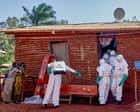
On 23 August, it will be 100 days since the Bundibugyo strain was first reported. How did it became the DRC’s most deadly outbreak and what must be done to stop it becoming the world’s largest? Almost 100 days ago, Africa’s public health watchdog reported an outbreak of Ebola in the Democratic Republic of the Congo. There have now been almost 5,000 cases and more than 2,000 deaths since 15 May, making this Ebola outbreak the biggest and most deadly in the DRC’s history. Continue reading...
Ebola outbreak out of control in Democratic Republic of the Congo, WHO says: ‘It is spreading faster than our ability to contain it’ EL PAÍS English Congo's M23 rebels introduce new movement restrictions over Ebola concerns Reuters The Guardian view on the Ebola outbreak in the DRC: a case study in why international aid matters | Editorial The Guardian What to know about the outbreak of a rare kind of Ebola PBS Congo's Ebola outbreak reaches...
Congo's M23 rebels introduce new movement restrictions over Ebola concerns Reuters The Guardian view on the Ebola outbreak in the DRC: a case study in why international aid matters | Editorial The Guardian DR Congo’s Ebola outbreak ‘global emergency’ as infections pass 5,000: WHO Al Jazeera What to know about the outbreak of a rare kind of Ebola PBS Congo's Ebola outbreak reaches 5,000 cases as it outpaces response efforts NPR
Congo’s Ebola outbreak reaches 5,000 cases as it outpaces response efforts at unprecedented speed AP News Congo's Ebola outbreak reaches 5,000 cases as it outpaces response efforts NPR Mobile gold miners in eastern Congo complicate health workers’ efforts to contain Ebola AP News Ebola in DRC: 'The evolution of this epidemic has exceeded our gravest expectations' Outbreak News Today Ebola outbreak now deadliest ever in DR Congo as death rate...
Community messages for DRC
Share how DRC's work has touched your life, ask questions, or offer help.