
Trees for the Future
Trees for the Future
About TREES
Trees for the Future stands as one of the most effective models of agroforestry-based development work in sub-Saharan Africa. Since 1989, this Maryland-based organization has trained hundreds of thousands of farming families to plant billions of trees in patterns that restore soil health, boost food security, and create sustainable income streams. By combining traditional knowledge with systematic training, they turn degraded farmland into productive Forest Gardens that feed families while healing ecosystems.
“Environmental restoration and poverty reduction are not competing priorities but mutually reinforcing goals that must be pursued simultaneously.”
History & Founding
Trees for the Future emerged during a period when international development organizations were beginning to recognize that tree planting alone could not solve the interconnected challenges facing rural communities in developing regions. Founded in 1989, the organization grew from an understanding that environmental restoration and poverty alleviation had to be approached as inseparable challenges. The founders recognized that smallholder farmers across Africa were trapped in cycles of soil degradation, declining yields, and deepening poverty, and that conventional aid models were failing to address root causes.
The early years focused on simple tree distribution programs, following the model common to many environmental nonprofits of that era. However, field experience quickly revealed limitations in this approach. Trees planted without proper training, without integration into farming systems, and without regard for farmers' economic needs often failed to survive or provide meaningful benefits. This recognition prompted a fundamental evolution in methodology. Rather than counting trees planted as the primary metric of success, the organization began developing comprehensive training programs that taught farmers how to strategically integrate trees into their agricultural practices.
Over three decades, this learning process has refined into what the organization now calls the Forest Garden Approach. This methodology represents years of trial, adaptation, and partnership with farming communities across multiple African nations. The evolution from a tree-planting charity into a sophisticated agroforestry training organization reflects broader shifts in development thinking, where local capacity building and systems-level change have replaced top-down interventions as best practice.
Mission & Approach
The core mission centers on ending hunger and poverty by training farmers to regenerate their land through strategic tree planting. This seemingly simple statement contains a sophisticated understanding of how environmental degradation, food insecurity, and economic marginalization reinforce one another in rural African contexts. The organization operates from the premise that farmers themselves are the most important agents of change, and that given proper training and support, they can transform degraded landscapes into productive, resilient ecosystems.
The Forest Garden Approach unfolds over four years of intensive training and support. Farmers learn to plant thousands of trees in specific patterns around their fields and homes, creating living systems that serve multiple functions simultaneously. These are not forests in the conventional sense, nor are they traditional farms. Instead, they represent a deliberate integration of fast-growing trees for fuel and building materials, nitrogen-fixing species that restore soil fertility, fruit and nut trees that provide nutrition and income, and vegetable crops that fill the understory. The design mimics natural forest ecosystems while remaining fundamentally productive agricultural systems.
What distinguishes this approach from conventional development work is its emphasis on patience and progression. Farmers move through distinct phases over the four-year training cycle. The first year focuses on establishing protective boundaries of trees around farm plots, creating living fences that prevent soil erosion and protect crops from livestock. Subsequent years layer in additional tree species, introduce new crops, and teach techniques for maximizing the ecological interactions between different plants. By the fourth year, farmers have established complex, productive systems that require less labor than conventional farming while producing greater yields and more diverse outputs.
The methodology rests on several key principles that challenge conventional agricultural development. First, it rejects the industrial model of monoculture farming that dominates much agricultural advice given to developing regions. Instead, it embraces diversity as both an ecological and economic strategy. Second, it treats soil health as the foundation of all other outcomes, recognizing that without living, fertile soil, no amount of external inputs can create sustainable productivity. Third, it acknowledges that environmental restoration and poverty reduction are not competing priorities but rather mutually reinforcing goals that must be pursued simultaneously.
Notable Programs & Impact
The organization's work spans multiple countries across sub-Saharan Africa, with significant operations in Kenya, Tanzania, Uganda, Senegal, and other nations where smallholder farmers face similar challenges of soil degradation and climate vulnerability. In each context, the core Forest Garden methodology adapts to local conditions, native species, cultural practices, and market opportunities while maintaining its fundamental principles. Field technicians work directly with farming communities, living in or near the villages where they train, building relationships over years rather than months.
The scale of tree planting that emerges from this training-focused model has been substantial. Farmers who complete the program typically plant thousands of trees on their own land, motivated by the tangible benefits they observe during the training cycle. These trees serve immediate practical purposes—providing firewood so families no longer spend hours collecting fuel, producing fruits and nuts that improve nutrition, generating timber and other products that can be sold for income. The environmental benefits, while significant, emerge as consequences of farmers pursuing their own economic interests rather than as abstract conservation goals imposed from outside.
Impact assessments conducted in partnership with academic researchers and independent evaluators have documented meaningful changes in farmer outcomes. Families who complete the Forest Garden training report increases in food security, with many moving from chronic hunger to year-round food sufficiency. Income gains enable investments in children's education, healthcare, and home improvements. Women, who perform the majority of agricultural labor in many African contexts, particularly benefit from the reduced workload that Forest Gardens require once established, freeing time for other economic activities or community involvement.
The ripple effects extend beyond individual farm families. As Forest Gardens mature, they begin changing local microclimates, moderating temperatures, and improving water retention in landscapes. Neighboring farmers observe the results and seek training themselves, creating organic expansion of agroforestry practices. Some program graduates become trainers themselves, extending the model within their own communities. The organization has trained hundreds of thousands of farmers since its founding, with each trained farmer representing a household of multiple family members whose lives are affected by the transformation of their land.
How They Work in the Field
The practical implementation of Forest Garden training requires deep local presence and cultural understanding. Field technicians are typically nationals of the countries where they work, hired from nearby communities or regions. They receive extensive training in agroforestry principles, adult education techniques, and the specific Forest Garden methodology. These technicians are not brief visitors but rather long-term partners to the farming communities they serve, visiting gardens regularly, troubleshooting problems, and adjusting approaches based on local conditions.
Farmer training happens through a combination of classroom-style group sessions and hands-on work in demonstration gardens and farmers' own fields. The curriculum covers topics ranging from seed selection and nursery management to pruning techniques and natural pest control. Importantly, it also addresses market access and business skills, recognizing that environmental restoration only contributes to poverty reduction when farmers can translate increased production into reliable income. Training groups often form lasting cooperative relationships, sharing labor during intensive planting periods and coordinating sales of surplus production.
The organization maintains nurseries that provide seedlings to participating farmers, addressing one of the most common barriers to tree planting in resource-poor communities. These nurseries grow both native species and introduced trees with proven benefits in similar climates, ensuring farmers have access to appropriate varieties for different purposes within their Forest Gardens. As farmers gain experience, many establish their own small nurseries, becoming seed sources for their neighbors and creating additional income streams.
Monitoring and evaluation systems track farmer progress through the four-year training cycle and beyond. Field staff document tree survival rates, crop yields, and household outcomes using standardized protocols that allow the organization to assess program effectiveness and identify areas for improvement. This data collection serves both accountability purposes and program development, as lessons learned in one region inform training approaches in others. The long-term nature of the engagement means staff witness the full transformation of landscapes and livelihoods, providing motivation and generating detailed knowledge about what works under different conditions.
Partnerships with local governments, agricultural extension services, and other development organizations help integrate Forest Garden approaches into broader rural development strategies. In some regions, government agricultural programs have adopted elements of the agroforestry methodology after observing its results. These partnerships extend the reach of the approach beyond what the organization could achieve alone, as public sector extension agents trained in Forest Garden principles carry the methodology into their own work with farming communities.
Recognition & Global Reach
The organization has earned recognition from environmental and development sectors for demonstrating that tree planting can be both ecologically restorative and economically transformative when integrated properly into farming systems. Agroforestry experts cite the Forest Garden model as an example of successful scaled implementation of principles that often remain theoretical or confined to small pilot projects. The systematic nature of the approach, with its clear phases and measurable outcomes, has made it a subject of interest for researchers studying sustainable agriculture and poverty reduction strategies.
Media coverage has brought wider attention to the model, with journalists and documentary filmmakers visiting Forest Garden sites to report on the transformation of degraded farmland into productive, green landscapes. These stories often highlight individual farmers whose lives have changed dramatically—families who moved from food insecurity to surplus production, children who could continue their education because of improved household income, women who gained economic independence through selling Forest Garden products. Such narratives illustrate the human dimension of environmental restoration work.
The organization's influence extends through its role in broader conversations about climate change, sustainable agriculture, and development effectiveness. As climate adaptation becomes increasingly urgent for vulnerable populations in Africa and elsewhere, the Forest Garden approach offers a proven model for building resilience at the community level. The trees planted create carbon sequestration benefits, though the organization emphasizes food security and farmer livelihoods as primary goals rather than positioning its work primarily through a climate lens. The climate benefits emerge as co-benefits of an approach designed first and foremost to serve farmer needs.
Looking forward, the organization continues refining its methodology and expanding its geographic reach while maintaining its fundamental commitment to patient, long-term work with individual farming families. In a development sector often pressured to demonstrate rapid results and massive scale, Trees for the Future represents an alternative model that prioritizes depth of impact and sustainability of outcomes over speed of expansion. The hundreds of thousands of farmers trained and the billions of trees planted emerge from this commitment to thoroughness rather than from shortcuts or superficial interventions.
Editorial profile generated with AI assistance (1757 words) based on publicly available information about Trees for the Future. Facts should be verified against the organization's official channels.
In the news
All briefings →Climate: Saving Old Trees Might Save Lives The New York Times
Fallen trees damage homes, knock out power in Kansas City, Kansas KCTV
Trees and power lines down in Kansas City, Kansas neighborhood KSHB 41 Kansas City
Climate change is forcing mountain trees to move — but not all in the same direction Utah Public Radio
A severe thunderstorm caused widespread damage, toppling trees and leaving thousands of residents without electrical power. Emergency crews are responding to the outages and clearing debris from affected areas.
Severe weather struck Kentucky, toppling trees and leaving approximately 100,000 customers without electricity. The powerful storm system caused widespread damage across the state, disrupting power infrastructure and creating hazardous conditions for residents.
Aug. 11 storm downs trees, damages property across Columbus The Columbus Dispatch
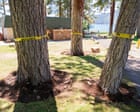
Incidents of damaged trees at Burnt Cedar beach have been reported since 2022 and seem to be linked, officials say Pine trees near Lake Tahoe are being poisoned in what authorities believe are a series of interconnected incidents in the popular tourist community on border of Nevada and California . The incidents have damaged nearly 30 trees, some reportedly more than a century old, and caused hundreds of thousands of dollars in losses. Continue reading...
Community messages for TREES
Share how TREES's work has touched your life, ask questions, or offer help.