
Daikon
Research status: AI draft — awaiting expert review


Overview
Daikon is a long, usually white radish grown for its crisp root and edible leafy tops. Common in East Asian cooking, it can be eaten raw, pickled, simmered, roasted, or stir-fried.
Origin & cultivation
Daikon belongs to the radish species, whose early domestication history is uncertain; long white forms were developed extensively in East Asia. China, Japan, and South Korea are major growing regions, with production elsewhere in Asia and worldwide.
Season
Daikon is available year-round in many markets, but fall and winter crops are often particularly sweet and crisp. Local harvest seasons vary with climate and variety.
Texture & flavor
Raw daikon is juicy and crunchy, with a mild peppery bite that is often stronger near the root tip. Cooking softens it to a tender, sometimes almost translucent texture and mellows its sharpness.
Nutrition
Typical values estimated with AI, not yet checked against lab data. For guidance only.
| Energy | 18 kcal | raw, per 100 g edible portion | FoodPulse AI estimate |
| Protein | 0.6 g | raw, per 100 g edible portion | FoodPulse AI estimate |
| Total fat | 0.1 g | raw, per 100 g edible portion | FoodPulse AI estimate |
| Saturated fat | 0.03 g | raw, per 100 g edible portion | FoodPulse AI estimate |
| Carbohydrate | 4.1 g | raw, per 100 g edible portion | FoodPulse AI estimate |
| Dietary fiber | 1.6 g | raw, per 100 g edible portion | FoodPulse AI estimate |
| Total sugars | 2.5 g | raw, per 100 g edible portion | FoodPulse AI estimate |
| Water | 94.62 g | raw, per 100 g edible portion | FoodPulse AI estimate |
| Calcium | 27 mg | raw, per 100 g edible portion | FoodPulse AI estimate |
| Iron | 0.4 mg | raw, per 100 g edible portion | FoodPulse AI estimate |
| Magnesium | 16 mg | raw, per 100 g edible portion | FoodPulse AI estimate |
| Potassium | 227 mg | raw, per 100 g edible portion | FoodPulse AI estimate |
| Sodium | 21 mg | raw, per 100 g edible portion | FoodPulse AI estimate |
| Zinc | 0.15 mg | raw, per 100 g edible portion | FoodPulse AI estimate |
| Vitamin C | 22 mg | raw, per 100 g edible portion | FoodPulse AI estimate |
| Vitamin A (RAE) | 0 µg | raw, per 100 g edible portion | FoodPulse AI estimate |
| Folate | 28 µg | raw, per 100 g edible portion | FoodPulse AI estimate |
| Vitamin B12 | 0 µg | raw, per 100 g edible portion | FoodPulse AI estimate |
| Cholesterol | 0 mg | raw, per 100 g edible portion | FoodPulse AI estimate |
Glycemic index: Not established.
Daikon provides vitamin C, some fiber, and relatively few calories; its nutrient content varies with portion and preparation. Radish allergy is uncommon but possible, and salt-pickled versions can contribute substantial sodium. Educational, not medical advice.
Educational information, not medical advice.
Storage
- Room temperature · 60–70°F (16–21°C), away from sunlight · About 1–2 days for a whole, uncut root; refrigeration is preferable. Keep dry and remove leafy tops to reduce moisture loss. Discard if moldy, slimy, leaking, or foul-smelling; refrigerate cut daikon rather than storing it on the counter. FoodPulse AI estimate
- Refrigerator · 32–40°F (0–4°C) · Whole root: about 1–2 weeks; cut root and greens: 3–5 days; cooked daikon: 3–4 days. Store the root dry in a bag or covered container, with greens separate. Refrigerate cut or cooked daikon within 2 hours, or 1 hour above 90°F (32°C). Discard for mold, slime, sour odors, or rotting patches. FoodPulse AI estimate
- Freezer · 0°F (−18°C) or below · About 2–3 months for best texture when frozen in cooked dishes. Freeze cooked daikon in shallow, airtight portions promptly after cooling safely; its texture will soften after thawing. Thaw in the refrigerator or reheat directly from frozen, bringing leftovers to 165°F (74°C). Continuous freezing preserves safety, but discard food mishandled before freezing or held above 40°F (4°C) for more than 2 hours after thawing. FoodPulse AI estimate
Preparation
Remove the leaves, trim the ends, and scrub the root under running water without soap; rinse greens thoroughly. Peel if the skin is tough or damaged, then grate, julienne, slice, or cube as needed. Keep daikon and its utensils separate from raw meat, poultry, fish, and seafood, and wash hands and equipment after handling those foods.
Cooking
Simmer 1-inch chunks for about 15–25 minutes, or thick rounds for 30–45 minutes, until a knife slides in easily. Stir-fry thin matchsticks for about 3–6 minutes, or roast 1-inch pieces at 425°F (220°C) for roughly 25–35 minutes, turning once. Timing varies with size, age, and desired tenderness; daikon itself has no USDA minimum internal-temperature requirement.
Recipes
No verified recipes yet.
Waste less
Use fresh greens in soups or sauté them, and add clean peelings to vegetable stock. Turn leftover cooked daikon into soup, curry, or fried rice, reheating leftovers to 165°F (74°C). Compost sound trimmings where accepted, but do not try to salvage moldy or rotting roots for food.
Food waste tips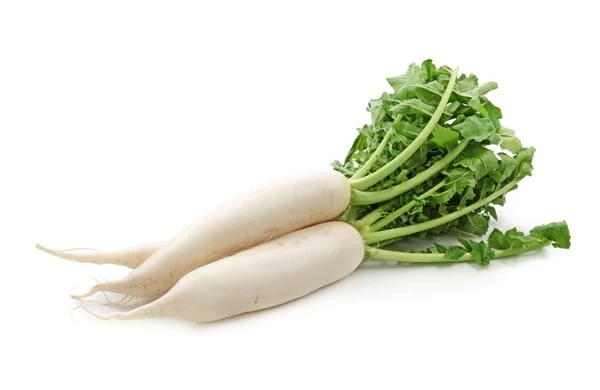 Daikon - White Radish