
Taro
Research status: AI draft — awaiting expert review


Overview
Taro is a tropical root vegetable grown for its starchy underground corm, often called a root. Its rough, hairy brown skin surrounds white, cream, or pale purple flesh, sometimes flecked with purple; both corms and edible leaves require thorough cooking.
Origin & cultivation
Taro was domesticated in tropical Asia, although its precise origin is debated, and spread widely through the Pacific. Major producing regions include West Africa, especially Nigeria, China, Southeast Asia, and Pacific islands.
Season
Taro is available year-round in many tropical growing regions and import markets, with local harvest peaks varying by climate. Choose firm, heavy corms without mold, soft patches, leaking areas, or a sour smell.
Texture & flavor
Thoroughly cooked taro has a mild, earthy, slightly nutty flavor and a dense, starchy texture that can become creamy when mashed. Depending on the variety and cooking method, it may be floury like a potato or pleasantly sticky.
Nutrition
Typical values estimated with AI, not yet checked against lab data. For guidance only.
| Energy | 112 kcal | raw, per 100 g edible portion | FoodPulse AI estimate |
| Protein | 1.5 g | raw, per 100 g edible portion | FoodPulse AI estimate |
| Total fat | 0.2 g | raw, per 100 g edible portion | FoodPulse AI estimate |
| Saturated fat | 0.041 g | raw, per 100 g edible portion | FoodPulse AI estimate |
| Carbohydrate | 26.46 g | raw, per 100 g edible portion | FoodPulse AI estimate |
| Dietary fiber | 4.1 g | raw, per 100 g edible portion | FoodPulse AI estimate |
| Total sugars | 0.4 g | raw, per 100 g edible portion | FoodPulse AI estimate |
| Water | 70.64 g | raw, per 100 g edible portion | FoodPulse AI estimate |
| Calcium | 43 mg | raw, per 100 g edible portion | FoodPulse AI estimate |
| Iron | 0.55 mg | raw, per 100 g edible portion | FoodPulse AI estimate |
| Magnesium | 33 mg | raw, per 100 g edible portion | FoodPulse AI estimate |
| Potassium | 591 mg | raw, per 100 g edible portion | FoodPulse AI estimate |
| Sodium | 11 mg | raw, per 100 g edible portion | FoodPulse AI estimate |
| Zinc | 0.23 mg | raw, per 100 g edible portion | FoodPulse AI estimate |
| Vitamin C | 4.5 mg | raw, per 100 g edible portion | FoodPulse AI estimate |
| Vitamin A (RAE) | 4 µg | raw, per 100 g edible portion | FoodPulse AI estimate |
| Folate | 22 µg | raw, per 100 g edible portion | FoodPulse AI estimate |
| Vitamin B12 | 0 µg | raw, per 100 g edible portion | FoodPulse AI estimate |
| Cholesterol | 0 mg | raw, per 100 g edible portion | FoodPulse AI estimate |
Glycemic index: Not established.
Taro provides carbohydrate, fiber, and potassium; nutrient amounts depend on variety, portion, and preparation. Raw or undercooked taro contains irritating calcium oxalate crystals that can cause mouth and throat burning, so never taste it raw. Taro allergy is possible, and people with kidney disease or prescribed oxalate restrictions should seek individualized advice. Educational, not medical advice.
Educational information, not medical advice.
Storage
- Cool room temperature, whole raw corms · 50–60°F (10–16°C), ideally · About 1–2 weeks; use sooner in a warmer kitchen. Store unwashed, dry, and ventilated, away from sunlight; avoid sealed plastic bags. Discard corms with mold, wet decay, leaking flesh, or sour odors. FoodPulse AI estimate
- Refrigerator, peeled or cut raw taro · 34–40°F (1–4°C) · 1–2 days. Refrigerate promptly in a covered container and cook thoroughly before eating. Discard if slimy, moldy, sour-smelling, or visibly decaying. FoodPulse AI estimate
- Refrigerator, cooked taro · 40°F (4°C) or below · 3–4 days. Refrigerate in shallow containers within 2 hours of cooking, or within 1 hour above 90°F (32°C). Reheat leftovers to 165°F (74°C); discard if left out too long, even if they look and smell normal, or if mold, slime, or off odors develop. FoodPulse AI estimate
- Freezer, cooked taro · 0°F (-18°C) or below · 2–3 months for best quality. Cool promptly, portion into airtight freezer containers, and freeze; continuous freezing keeps food safe longer, though texture deteriorates. Thaw in the refrigerator or reheat from frozen to 165°F (74°C); discard thawed portions held above 40°F (4°C) for more than 2 hours. FoodPulse AI estimate
Preparation
Scrub the corm under running water, trim damaged areas, and peel with a knife or sturdy peeler; gloves help prevent irritation from raw taro juices. Cut into even pieces on a stable board, keeping it separate from raw meat, poultry, and seafood and washing hands, knives, and boards after handling those foods. Use only taro sold for food, not ornamental look-alikes.
Cooking
Boil peeled 1-inch chunks in plenty of water for about 20–30 minutes, or larger pieces for 30–45 minutes or longer, until completely tender throughout; drain and discard the water. For crisp edges, roast boiled, drained pieces with a little oil at 400°F (205°C) for about 20–30 minutes. Times vary with size and variety: do not serve pieces with a hard or chalky center, and obtain separate, variety-appropriate instructions for taro leaves, which need prolonged cooking.
Recipes
No verified recipes yet.
Waste less
Peel thinly to preserve the usable flesh, but discard rotten or moldy corms rather than trying to salvage them. Mash cooked leftovers, add them to soup, or form them into patties within their safe refrigerated life. Compost uncooked peels and sound trimmings where appropriate, keeping them away from children and pets; do not eat the peels raw.
Food waste tips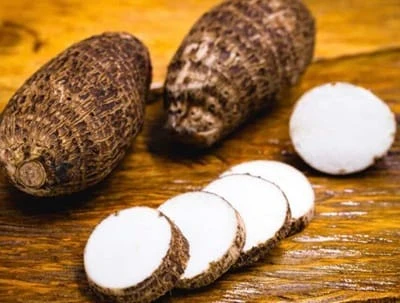 Taro (Chembu)