
Plantain
Research status: AI draft — awaiting expert review


Overview
Plantains are starchy cooking bananas, generally larger and firmer than dessert bananas. They are commonly cooked at every stage of ripeness, from green to yellow to nearly black.
Origin & cultivation
Plantains trace their ancestry to banana species from Southeast Asia and the western Pacific. Major growing regions today include West and Central Africa, Latin America, the Caribbean, and tropical Asia.
Season
Plantains grow year-round in tropical climates and are generally available throughout the year. Choose green fruit for savory, firm preparations and yellow or black-skinned fruit for sweeter dishes.
Texture & flavor
Green plantains are firm, starchy, and mildly flavored, with a potato-like texture when cooked. Yellow plantains become softer and sweeter; fully ripe, black-skinned fruit develops a creamy interior and caramelizes readily.
Nutrition
Typical values estimated with AI, not yet checked against lab data. For guidance only.
| Energy | 122 kcal | raw, per 100 g edible portion | FoodPulse AI estimate |
| Protein | 1.3 g | raw, per 100 g edible portion | FoodPulse AI estimate |
| Total fat | 0.37 g | raw, per 100 g edible portion | FoodPulse AI estimate |
| Saturated fat | 0.143 g | raw, per 100 g edible portion | FoodPulse AI estimate |
| Carbohydrate | 31.89 g | raw, per 100 g edible portion | FoodPulse AI estimate |
| Dietary fiber | 2.3 g | raw, per 100 g edible portion | FoodPulse AI estimate |
| Total sugars | 15 g | raw, per 100 g edible portion | FoodPulse AI estimate |
| Water | 65.28 g | raw, per 100 g edible portion | FoodPulse AI estimate |
| Calcium | 3 mg | raw, per 100 g edible portion | FoodPulse AI estimate |
| Iron | 0.6 mg | raw, per 100 g edible portion | FoodPulse AI estimate |
| Magnesium | 37 mg | raw, per 100 g edible portion | FoodPulse AI estimate |
| Potassium | 499 mg | raw, per 100 g edible portion | FoodPulse AI estimate |
| Sodium | 4 mg | raw, per 100 g edible portion | FoodPulse AI estimate |
| Zinc | 0.14 mg | raw, per 100 g edible portion | FoodPulse AI estimate |
| Vitamin C | 18.4 mg | raw, per 100 g edible portion | FoodPulse AI estimate |
| Vitamin A (RAE) | 56 µg | raw, per 100 g edible portion | FoodPulse AI estimate |
| Folate | 22 µg | raw, per 100 g edible portion | FoodPulse AI estimate |
| Vitamin B12 | 0 µg | raw, per 100 g edible portion | FoodPulse AI estimate |
| Cholesterol | 0 mg | raw, per 100 g edible portion | FoodPulse AI estimate |
Glycemic index: Not established.
Plantains provide carbohydrate, fiber, potassium, and vitamin B6; green plantains also contain resistant starch, whose amount changes with ripening and cooking. Frying adds substantial fat and calories, while boiling or baking requires little added fat. Plantain allergy is possible, including cross-reactions in some people with banana or latex allergy. Educational, not medical advice.
Educational information, not medical advice.
Storage
- Room temperature · 60–75°F (16–24°C) · About 3–7 days for green fruit to ripen; use fully ripe fruit within 1–2 days.. Keep whole fruit dry, ventilated, and out of direct sunlight; ripening speed varies considerably. Black skin alone is normal in ripe plantains, but discard fruit with mold, leaking flesh, slime, or a sour or fermented odor. FoodPulse AI estimate
- Refrigerator · 32–40°F (0–4°C) · Ripe whole fruit: about 3–5 days; peeled or cut fruit: 2–3 days; cooked leftovers: 3–4 days.. Refrigeration darkens the peel and can disrupt ripening of green fruit. Cover cut fruit and refrigerate cooked plantains in shallow containers within 2 hours, or 1 hour above 90°F (32°C). Discard moldy, slimy, or sour-smelling fruit and leftovers held too long, even if they look normal. FoodPulse AI estimate
- Freezer · 0°F (−18°C) or below · About 2–3 months for best quality; continuously frozen food remains safe longer.. Peel and portion before freezing in airtight packaging; cooked pieces or mash also freeze well. Thaw in the refrigerator or cook directly from frozen. Freezer burn affects quality rather than safety; discard food that was mishandled before freezing or held above 40°F (4°C) for more than 2 hours after thawing. FoodPulse AI estimate
Preparation
Rinse the intact plantain under running water before cutting; do not use soap. Trim both ends, score the peel lengthwise without cutting deeply into the flesh, and pull it away; cut into rounds, diagonal slices, or chunks. Use clean utensils and a separate cutting board from raw meat, poultry, or seafood, and wash hands and surfaces after handling those foods.
Cooking
Boil peeled chunks until fork-tender, usually 15–25 minutes depending on size and ripeness, or bake slices at 400°F (204°C) for about 20–35 minutes, turning once. Pan-fry ripe slices for roughly 2–4 minutes per side, depending on thickness, until browned and tender. For twice-fried green plantains, fry thick rounds for 3–5 minutes, flatten, then fry another 2–3 minutes until crisp; adjust timing to thickness and oil temperature.
Recipes
No verified recipes yet.
Waste less
Use green plantains for savory sides and very ripe ones for sweet baked dishes rather than discarding them solely because the skin is black. Refrigerate cooked leftovers promptly and repurpose them in soups, mash, or breakfast hash. Compost peels and trimmed ends where accepted; discard rather than salvage moldy or spoiled fruit.
Food waste tips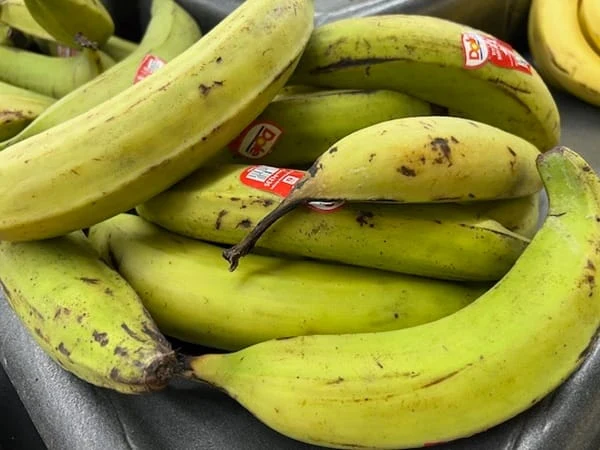 Plantains (Large Bananas)