
Ridge gourd
Research status: AI draft — awaiting expert review


Overview
Ridge gourd (Luffa acutangula) is a long, green vegetable with pronounced lengthwise ribs, harvested while young and tender. Also called angled luffa, turai, or beerakaya, it belongs to the cucumber family; fully mature fruits become fibrous rather than suitable for everyday cooking.
Origin & cultivation
Ridge gourd is generally considered native to tropical Asia, although its precise origin is uncertain. It is widely cultivated in India, China, and South and Southeast Asia, with smaller-scale production in other warm regions.
Season
Ridge gourd thrives in warm weather and is typically harvested from summer into early autumn in temperate regions. In tropical areas, successive plantings can provide it for much of the year.
Texture & flavor
Young ridge gourd has moist, tender flesh with a mild, slightly sweet flavor that readily absorbs seasonings. Its ribs and older skin can be tough, while overmature fruits develop coarse fibers and hard seeds.
Nutrition
Typical values estimated with AI, not yet checked against lab data. For guidance only.
| Energy | 20 kcal | raw, per 100 g edible portion | FoodPulse AI estimate |
| Protein | 1.2 g | raw, per 100 g edible portion | FoodPulse AI estimate |
| Total fat | 0.2 g | raw, per 100 g edible portion | FoodPulse AI estimate |
| Saturated fat | 0.023 g | raw, per 100 g edible portion | FoodPulse AI estimate |
| Carbohydrate | 4.35 g | raw, per 100 g edible portion | FoodPulse AI estimate |
| Dietary fiber | 1.1 g | raw, per 100 g edible portion | FoodPulse AI estimate |
| Total sugars | 2.02 g | raw, per 100 g edible portion | FoodPulse AI estimate |
| Water | 93.85 g | raw, per 100 g edible portion | FoodPulse AI estimate |
| Calcium | 20 mg | raw, per 100 g edible portion | FoodPulse AI estimate |
| Iron | 0.36 mg | raw, per 100 g edible portion | FoodPulse AI estimate |
| Magnesium | 14 mg | raw, per 100 g edible portion | FoodPulse AI estimate |
| Potassium | 139 mg | raw, per 100 g edible portion | FoodPulse AI estimate |
| Sodium | 3 mg | raw, per 100 g edible portion | FoodPulse AI estimate |
| Zinc | 0.07 mg | raw, per 100 g edible portion | FoodPulse AI estimate |
| Vitamin C | 12 mg | raw, per 100 g edible portion | FoodPulse AI estimate |
| Vitamin A (RAE) | 21 µg | raw, per 100 g edible portion | FoodPulse AI estimate |
| Folate | 7 µg | raw, per 100 g edible portion | FoodPulse AI estimate |
| Vitamin B12 | 0 µg | raw, per 100 g edible portion | FoodPulse AI estimate |
| Cholesterol | 0 mg | raw, per 100 g edible portion | FoodPulse AI estimate |
Glycemic index: Not established.
Ridge gourd supplies water, some fiber, and modest amounts of vitamins and minerals; evidence does not establish it as a treatment for disease. Allergy is possible, particularly in people with known reactions to related gourds, so avoid it if it has caused symptoms. Unusually strong bitterness can indicate potentially toxic cucurbitacins: discard the entire fruit, since cooking does not reliably make it safe. Educational, not medical advice.
Educational information, not medical advice.
Storage
- Room temperature · 60–75°F (16–24°C) · Preferably use the same day; up to 1–2 days if whole and sound.. Keep whole gourds dry, shaded, and ventilated; refrigerate sooner in hot conditions. Discard if moldy, slimy, leaking, or foul-smelling; refrigerate cut pieces promptly. FoodPulse AI estimate
- Refrigerator · 34–40°F (1–4°C) · Whole: about 4–7 days; cut: 2–3 days; cooked: 3–4 days.. Store whole, unwashed gourds in a perforated bag in the crisper and cut or cooked portions in covered containers. Refrigerate cut or cooked gourd within 2 hours, or 1 hour above 90°F (32°C). Discard for mold, slime, sour odor, or unsafe time out of refrigeration; harmful bacteria may not cause visible changes. FoodPulse AI estimate
- Freezer · 0°F (-18°C) or below · Cooked portions: about 2–3 months for best quality.. Cook until just tender, cool promptly in shallow containers, and freeze in airtight meal-size portions; expect a softer texture after thawing. Thaw in the refrigerator or reheat directly from frozen to 165°F (74°C). Continuous freezing keeps food safe longer than this quality window, but does not rescue food mishandled before freezing. FoodPulse AI estimate
Preparation
Rinse under running water before cutting, rubbing the ridges to remove dirt; do not use soap. Trim both ends, shave off the tough ribs, and peel more deeply only if the skin is coarse, then slice or dice; remove firm seeds or fibrous centers. Keep the vegetable and its cutting tools separate from raw meat, poultry, fish, and seafood, and wash hands and equipment after handling those foods.
Cooking
Stir-fry thin slices for about 5–8 minutes, or simmer 1–2 cm pieces in curries, soups, or dal for roughly 10–15 minutes, until tender. Larger chunks may need 15–20 minutes, depending on maturity and heat. Ridge gourd releases considerable water, so start with little added liquid and adjust as it cooks.
Recipes
No verified recipes yet.
Waste less
Use tender flesh and soft seeds together; thin, tender peel can also be cooked into chutney after thorough washing. Add refrigerated cooked leftovers to soup or dal within 3–4 days and reheat to 165°F (74°C). Compost tough ribs, stems, and fibrous trimmings where accepted, but never reuse an unusually bitter fruit for food.
Food waste tips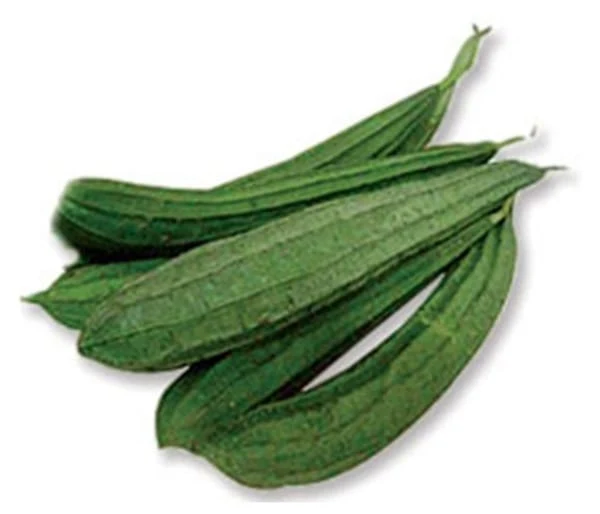 Ridge Gourd - Loofah -Chinese Okra