
Pear
Research status: AI draft — awaiting expert review


Overview
Pears are thin-skinned fruits with a seed-filled core, commonly eaten fresh or cooked. Varieties include soft, juicy European pears such as Bartlett and Anjou, and crisp, round Asian pears.
Origin & cultivation
European pears originated in parts of Europe and western Asia, while Asian pears were domesticated in East Asia. China dominates global production; other important producers include Argentina, Italy, Turkey, South Africa, and the United States, especially Washington and Oregon.
Season
In the Northern Hemisphere, locally harvested pears are most abundant from late summer through fall, with timing depending on variety. Refrigerated storage and imports make them available year-round; Southern Hemisphere harvests generally run from late summer into autumn there.
Texture & flavor
European pears become tender, juicy, and sweet as they ripen, sometimes with a slightly grainy texture. Asian pears remain crisp and watery when ripe, with mild sweetness. Bosc pears are relatively firm and hold their shape well when cooked.
Nutrition
Typical values estimated with AI, not yet checked against lab data. For guidance only.
| Energy | 57 kcal | raw, per 100 g edible portion | FoodPulse AI estimate |
| Protein | 0.36 g | raw, per 100 g edible portion | FoodPulse AI estimate |
| Total fat | 0.14 g | raw, per 100 g edible portion | FoodPulse AI estimate |
| Saturated fat | 0.022 g | raw, per 100 g edible portion | FoodPulse AI estimate |
| Carbohydrate | 15.23 g | raw, per 100 g edible portion | FoodPulse AI estimate |
| Dietary fiber | 3.1 g | raw, per 100 g edible portion | FoodPulse AI estimate |
| Total sugars | 9.75 g | raw, per 100 g edible portion | FoodPulse AI estimate |
| Water | 83.96 g | raw, per 100 g edible portion | FoodPulse AI estimate |
| Calcium | 9 mg | raw, per 100 g edible portion | FoodPulse AI estimate |
| Iron | 0.18 mg | raw, per 100 g edible portion | FoodPulse AI estimate |
| Magnesium | 7 mg | raw, per 100 g edible portion | FoodPulse AI estimate |
| Potassium | 116 mg | raw, per 100 g edible portion | FoodPulse AI estimate |
| Sodium | 1 mg | raw, per 100 g edible portion | FoodPulse AI estimate |
| Zinc | 0.1 mg | raw, per 100 g edible portion | FoodPulse AI estimate |
| Vitamin C | 4.3 mg | raw, per 100 g edible portion | FoodPulse AI estimate |
| Vitamin A (RAE) | 1 µg | raw, per 100 g edible portion | FoodPulse AI estimate |
| Folate | 7 µg | raw, per 100 g edible portion | FoodPulse AI estimate |
| Vitamin B12 | 0 µg | raw, per 100 g edible portion | FoodPulse AI estimate |
| Cholesterol | 0 mg | raw, per 100 g edible portion | FoodPulse AI estimate |
Glycemic index: Not established.
Pears provide fiber, especially when eaten with the skin, plus modest amounts of vitamin C; fiber supports normal bowel function. Their fructose and sorbitol may cause digestive symptoms in sensitive people. Pear allergy is possible, including pollen-food allergy syndrome in people sensitive to birch pollen; cooking does not reliably make them safe for everyone with an allergy. Educational, not medical advice.
Educational information, not medical advice.
Storage
- Room temperature · About 60–75°F (16–24°C) · Usually 2–7 days to ripen European pears; check daily.. Keep whole pears out of direct sunlight. European pears are ready when the neck yields slightly to gentle pressure; Asian pears are generally sold ripe and are best refrigerated. Discard pears with mold, leaking decay, or a fermented odor. FoodPulse AI estimate
- Refrigerator · 32–40°F (0–4°C) · Ripe European pears: about 3–7 days; sound Asian pears: often 2–3 weeks; cut pears: 3–4 days.. Store whole pears in the crisper and cut pears in a covered container. Refrigerate cut fruit within 2 hours, or 1 hour above 90°F (32°C). Discard for mold, slime, or sour or fermented odors; simple cut-surface browning is not itself spoilage. FoodPulse AI estimate
- Freezer · 0°F (-18°C) or below · About 8–12 months for best quality; continuously frozen fruit remains safe longer.. For NCHFP-style freezing, peel, core, slice, and briefly heat pears in syrup before cooling and packing in freezer-safe containers with headspace. Thaw in the refrigerator; softened texture is normal and suits cooked dishes. Discard thawed fruit with mold, slime, or off odors, and do not freeze spoiled fruit. FoodPulse AI estimate
Preparation
Rinse under running water before cutting or eating, rubbing the skin gently; do not use soap or produce detergent. Remove the stem and core, then slice or dice, peeling only if desired; a little lemon juice slows browning. Use clean hands, knives, and boards, and keep pears separate from raw meat, poultry, seafood, and their juices.
Cooking
Poach peeled halves gently for about 15–30 minutes, depending on size and ripeness, until a knife slips in easily. Bake halves at 375°F (190°C) for roughly 25–45 minutes, or sauté thin slices for 5–10 minutes. Firm pears suit roasting and tarts, while very ripe, sound pears cook quickly into sauce or compote.
Recipes
No verified recipes yet.
Waste less
Leave edible skins on for snacks, salads, or sauces, and use soft but unspoiled pears in smoothies, baking, or compote. Refrigerate cooked leftovers promptly and use within 3–4 days, or freeze in portions. Compost stems, cores, and spoiled fruit where accepted; do not try to salvage moldy pears by trimming.
Food waste tips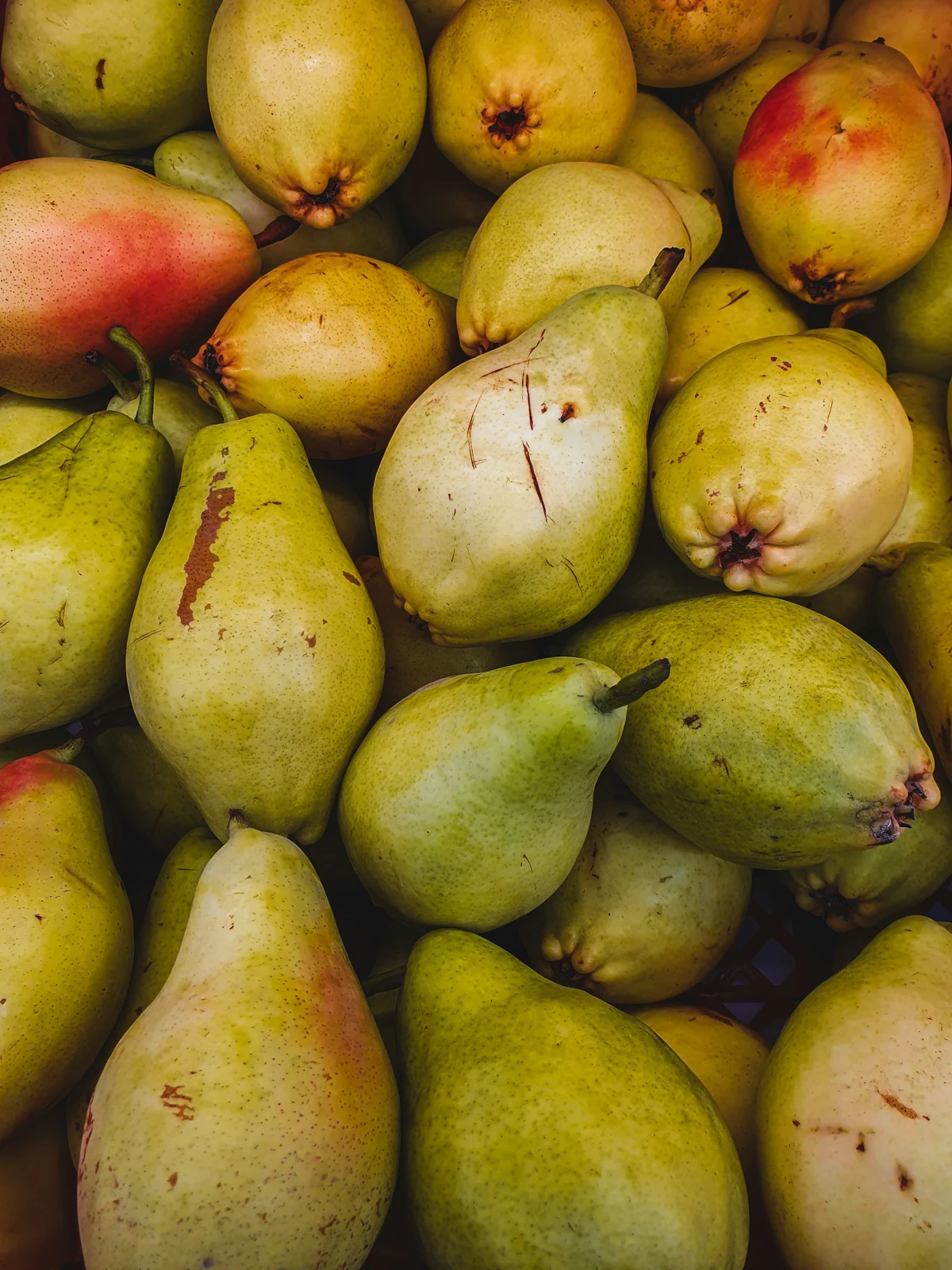 Pears (Fruit)