
Scallop
Research status: AI draft — awaiting expert review


Overview
Scallops are marine bivalve mollusks; the round white portion commonly sold is the muscle that opens and closes the shell. Large sea scallops suit searing, while smaller bay scallops work well in quick sautés, soups, and pasta.
Origin & cultivation
Scallops are wild-caught or farmed in temperate and cold coastal waters. Major producing regions include China, Japan, the North Atlantic off the United States and Canada, and parts of Europe and South America.
Season
Fresh availability varies by species, location, fishing rules, and weather; some fisheries operate year-round, while others have defined seasons. Frozen scallops are available throughout the year and can be an excellent alternative to fresh.
Texture & flavor
Scallops have a mild, sweet, briny flavor and tender, slightly springy flesh when properly cooked. Overcooking makes them firm and rubbery; untreated or “dry-packed” scallops generally brown better than phosphate-treated “wet-packed” ones.
Nutrition
Typical values estimated with AI, not yet checked against lab data. For guidance only.
| Energy | 69 kcal | raw, per 100 g edible portion | FoodPulse AI estimate |
| Protein | 12.06 g | raw, per 100 g edible portion | FoodPulse AI estimate |
| Total fat | 0.49 g | raw, per 100 g edible portion | FoodPulse AI estimate |
| Saturated fat | 0.128 g | raw, per 100 g edible portion | FoodPulse AI estimate |
| Carbohydrate | 3.18 g | raw, per 100 g edible portion | FoodPulse AI estimate |
| Dietary fiber | 0 g | raw, per 100 g edible portion | FoodPulse AI estimate |
| Total sugars | 0 g | raw, per 100 g edible portion | FoodPulse AI estimate |
| Water | 82.53 g | raw, per 100 g edible portion | FoodPulse AI estimate |
| Calcium | 6 mg | raw, per 100 g edible portion | FoodPulse AI estimate |
| Iron | 0.38 mg | raw, per 100 g edible portion | FoodPulse AI estimate |
| Magnesium | 22 mg | raw, per 100 g edible portion | FoodPulse AI estimate |
| Potassium | 205 mg | raw, per 100 g edible portion | FoodPulse AI estimate |
| Sodium | 392 mg | raw, per 100 g edible portion | FoodPulse AI estimate |
| Zinc | 0.91 mg | raw, per 100 g edible portion | FoodPulse AI estimate |
| Vitamin C | 0 mg | raw, per 100 g edible portion | FoodPulse AI estimate |
| Vitamin A (RAE) | 1 µg | raw, per 100 g edible portion | FoodPulse AI estimate |
| Folate | 16 µg | raw, per 100 g edible portion | FoodPulse AI estimate |
| Vitamin B12 | 1.41 µg | raw, per 100 g edible portion | FoodPulse AI estimate |
| Cholesterol | 24 mg | raw, per 100 g edible portion | FoodPulse AI estimate |
Glycemic index: Not applicable / not meaningful (very little carbohydrate).
Scallops provide protein, vitamin B12, and selenium and are generally a lower-mercury seafood choice. They can trigger molluscan shellfish allergy, and raw or undercooked scallops carry infection risks, particularly for pregnant people, older adults, and people with weakened immunity. Educational, not medical advice.
Educational information, not medical advice.
Storage
- Room temperature — preparation or serving only · Above 40°F (4°C); especially hazardous above 90°F (32°C) · No more than 2 hours total out of refrigeration, or 1 hour above 90°F (32°C).. Do not store scallops on the counter or thaw them there. Discard after these time limits even if they smell normal; cooking does not reliably make temperature-abused seafood safe. FoodPulse AI estimate
- Refrigerator · 32–40°F (0–4°C) · Raw: 1–2 days; cooked: 3–4 days.. Keep covered in a leakproof container on a low shelf, separate from ready-to-eat foods. Discard scallops with sour or ammonia-like odors, unusual discoloration, or pronounced slime; absence of these signs does not establish safety. FoodPulse AI estimate
- Freezer · 0°F (-18°C) or below · Raw: about 3–6 months for best quality; cooked: about 3 months for best quality.. Package airtight, remove excess air, and label with the date. Continuously frozen food remains safe indefinitely, though quality declines; freezer burn alone is not a safety issue. Discard thawed scallops held above 40°F (4°C) for more than 2 hours. FoodPulse AI estimate
Preparation
Thaw in the refrigerator, or in a leakproof bag in cold water, changing the water every 30 minutes and cooking immediately afterward. Remove the tough side muscle if attached; routine washing is unnecessary, but briefly rinse visible grit under gentle cold running water without splashing, then pat dry. Leave whole or cut large scallops into even pieces, and keep raw seafood, juices, utensils, and cutting boards separate from ready-to-eat foods; wash hands and clean surfaces afterward.
Cooking
Sear, broil, grill, poach, or bake scallops; in a hot skillet, large sea scallops often take about 2–3 minutes per side, while small bay scallops may take 2–4 minutes total, depending on size and heat. Follow USDA guidance to cook seafood to an internal temperature of 145°F (63°C), checking the center of the thickest scallop with a food thermometer. Flesh should be pearly or white and opaque, but timing and appearance do not replace a temperature check.
Recipes
No verified recipes yet.
Waste less
Save clean side muscles for cooked seafood stock, straining them out afterward; do not assume the viscera of whole scallops are safe to eat, because some shellfish toxins are not destroyed by cooking. Refrigerate cooked leftovers promptly and use in pasta, rice, or soup within 3–4 days, reheating to 165°F (74°C). Keep seafood scraps out of ordinary backyard compost because they attract pests; use a municipal program only if it accepts them, and check local rules for shells.
Food waste tips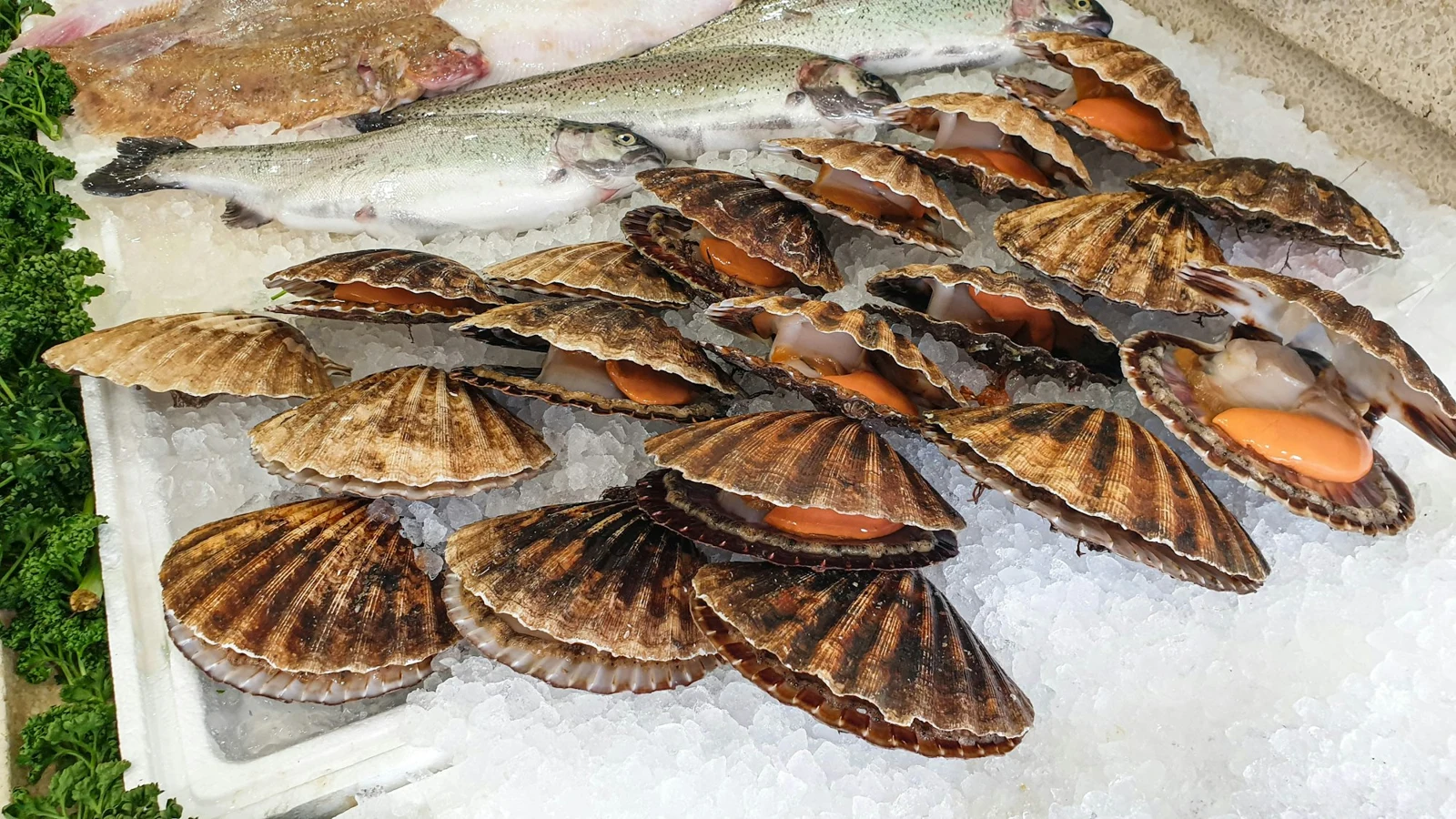 Scallops